CDU Liquid Cooling in the High-Compute Data Center Era: Upgrading from “Running” to “Operations Management”
As data centers enter the high-compute era, the focus of liquid cooling systems is changing. For cooling distribution units, also known as CDUs, the challenge is no longer only about circulating coolant through the designed loop. It is also about whether the system can maintain stable and predictable cooling performance during long-term operation.
Many risks do not appear as instant failures. Instead, they accumulate through gradual deviation: filters become progressively clogged, pump efficiency declines, pipeline resistance changes, entrained air bubbles cause flow fluctuations, and small leaks lead to pressure abnormalities. These issues may be hidden under low-load conditions. Once the system enters high-load or extreme operating conditions, they can quickly develop into reduced heat exchange efficiency, local hot spots, system derating, or even unplanned downtime.
To upgrade a CDU from simply “being able to run” to “being manageable in operation,” the key is to make critical system variables continuously visible, traceable through trends, and locatable when abnormalities occur. Sentinel’s approach for CDU applications is to first establish the three most common and most valuable process variables: pressure, temperature, and flow. These field data points can then be uniformly connected to the control and monitoring system through an IO-Link master.
In this way, even if the project does not aim to cover every monitoring dimension at once, the operating status of the CDU can still be detected earlier and explained faster. Maintenance actions can gradually shift from passive emergency repair to planned intervention.
The Three Main Variables Worth Monitoring First in a CDU
In a CDU, temperature is often the most intuitive indicator, but it mostly reflects the result. When the temperature has already become abnormal, the problem may have been developing inside the loop for some time. To turn fault location from “guesswork” into an evidence-based process, pressure and flow are needed to provide information from the cause side.
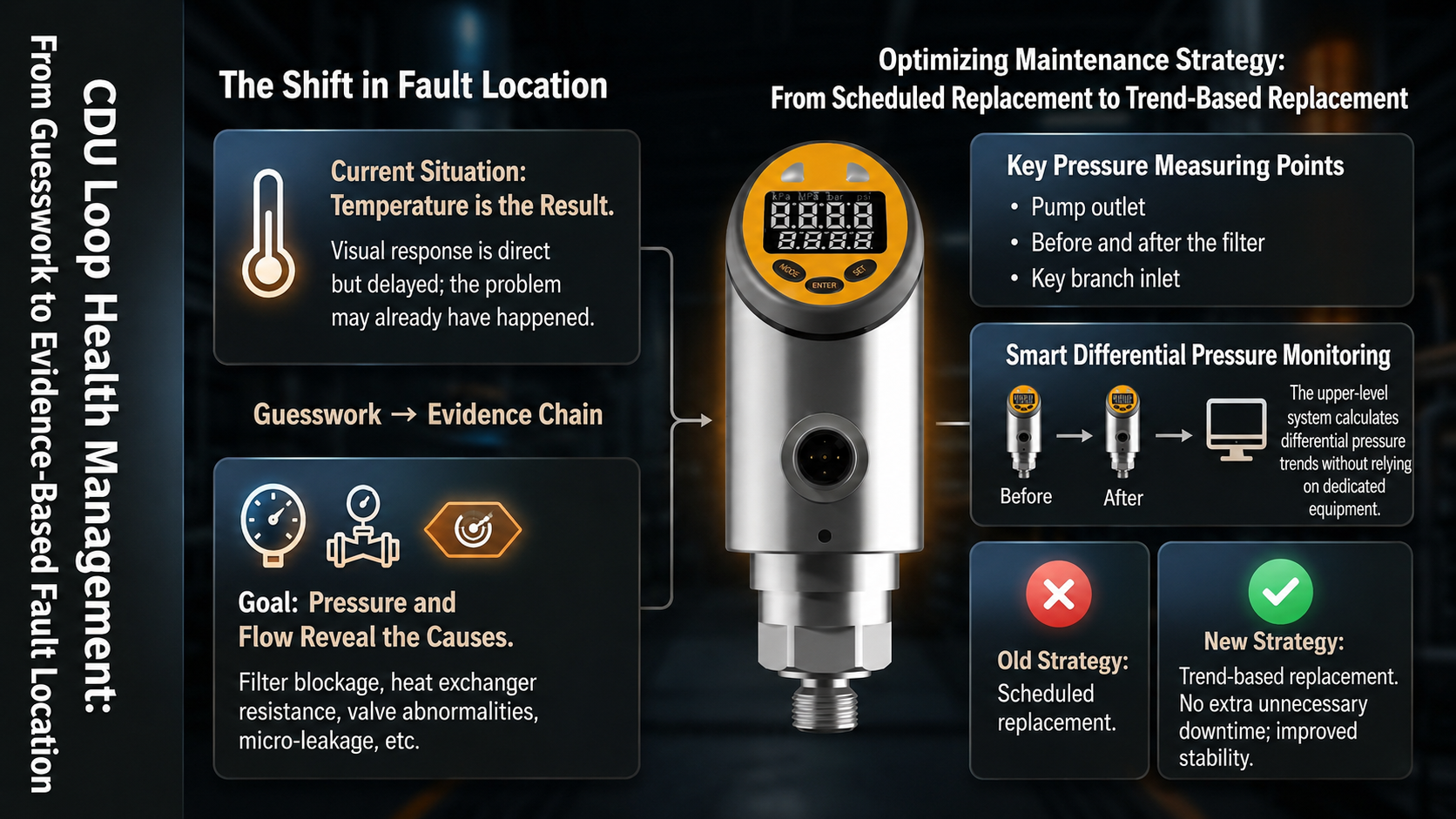
Pressure is an important reflection of loop health. Filter blockage, increased heat exchanger resistance, valve abnormalities, local pipe contraction, and even micro-leakage may all leave traces in pressure fluctuations or differential pressure trends.
In engineering practice, pressure measuring points are commonly placed at the pump outlet, before and after the filter, and at the inlet of key branches. For filter condition monitoring, it is not always necessary to rely on a dedicated differential pressure device. Two pressure sensors can be used to collect pressure before and after the filter, and the differential pressure trend can then be calculated in the upper-level system. This can also form an actionable basis for maintenance.
In this way, maintenance strategy can gradually move from “scheduled replacement” to “trend-based replacement,” improving stability without adding unnecessary downtime.
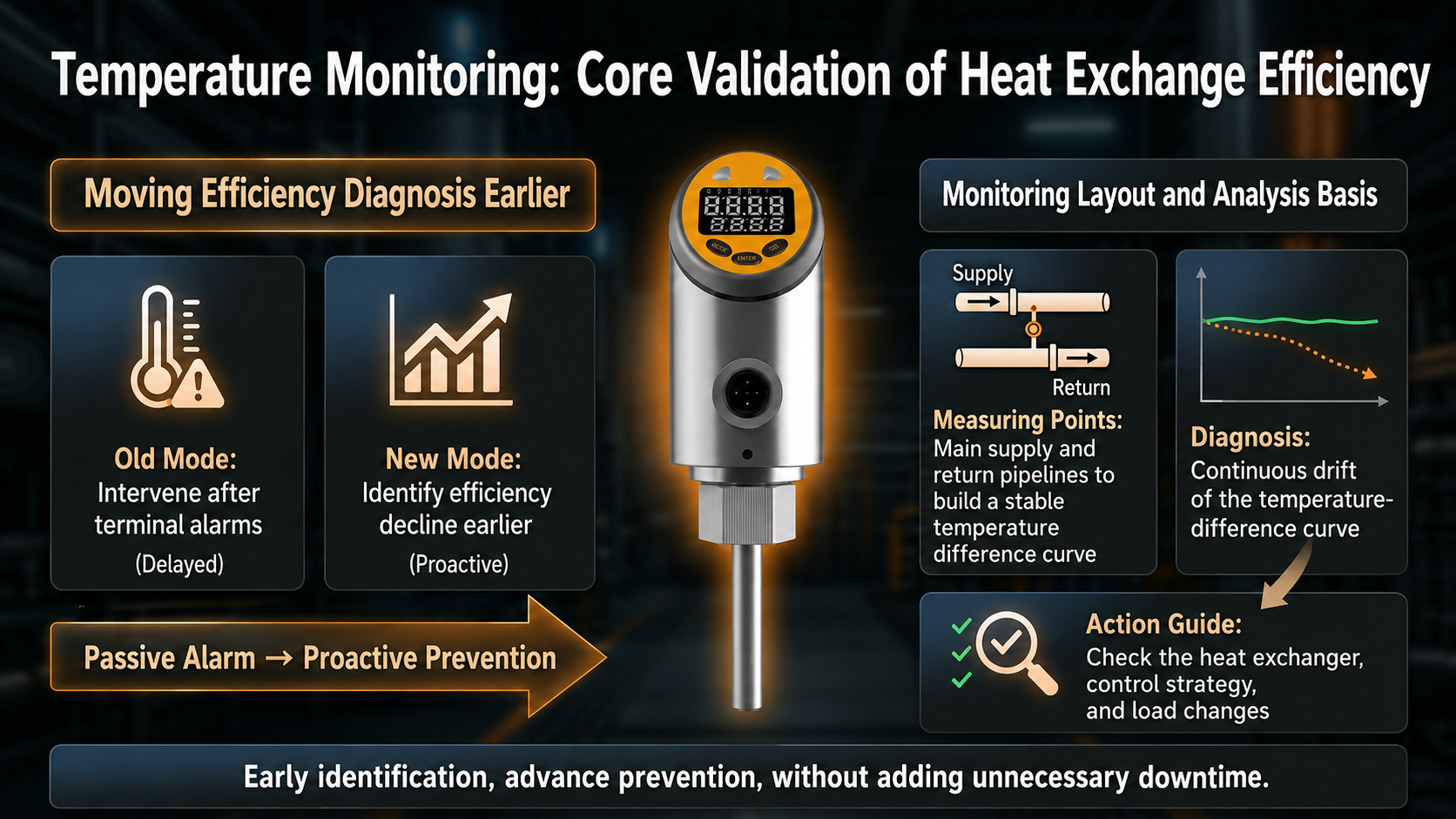
Temperature is used to verify whether heat exchange is effective. The trends of CDU supply and return coolant temperatures, temperature changes before and after the heat exchanger, and the stability of temperature difference under different loads can help operation and maintenance teams identify declining efficiency earlier, instead of waiting until terminal alarms occur.
Temperature measuring points are usually suitable for installation on the main supply and return pipelines, so that a stable temperature difference curve can be formed. When this curve shows continuous drift, there is a clearer direction for checking the heat exchanger condition, control strategy, or load-side changes.
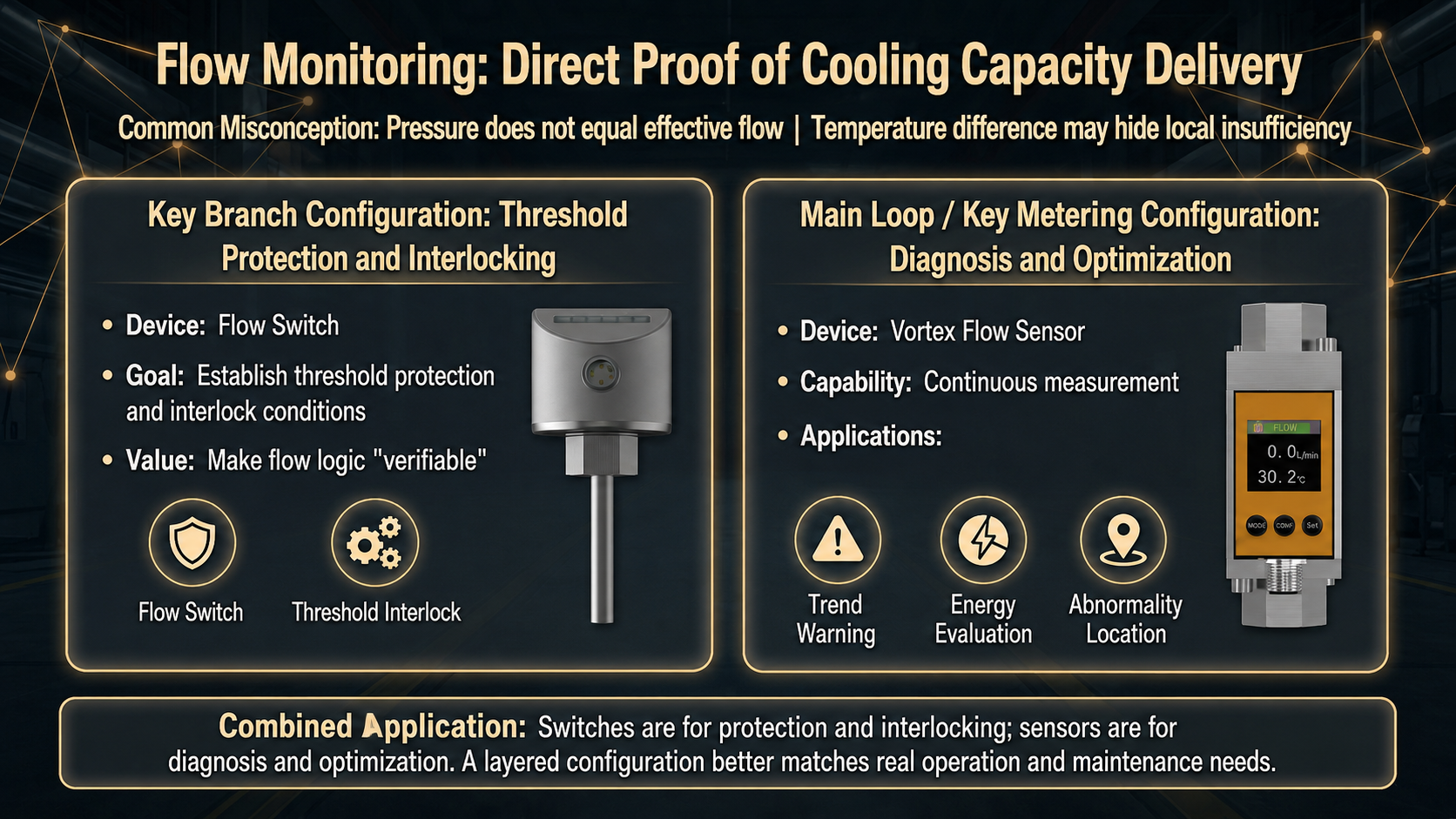
Flow is direct proof of cooling capacity delivery. A CDU may have pressure, but that does not necessarily mean it has effective flow. Similarly, even if the temperature difference appears normal, insufficient local flow in certain branches may still be hidden by average values.
Sentinel recommends a layered configuration for flow monitoring. Flow switches can be used in key branches to establish threshold protection and interlock conditions, making “required flow” a verifiable logic in the system. Vortex flow sensors can be used in the main loop or key metering sections to provide continuous measurement for trend warning, energy efficiency evaluation, and abnormality location.
The former focuses more on protection and interlocking, while the latter focuses more on diagnosis and optimization. The combination of both is closer to the real operation and maintenance needs of CDU systems.
When pressure, temperature, and flow form a stable monitoring loop, many hidden problems can reveal their early outlines. For example, when a filter gradually becomes blocked, the first sign is often a slow increase in differential pressure. Then the main loop flow may begin to decline marginally, and finally the temperature difference trend may change. If monitoring relies only on temperature alarms, the issue is often discovered close to the risk boundary.
By contrast, when all three variables are visible in the system, abnormalities can be identified earlier, and maintenance planning becomes more controllable.
The Value of IO-Link Masters in CDU Applications
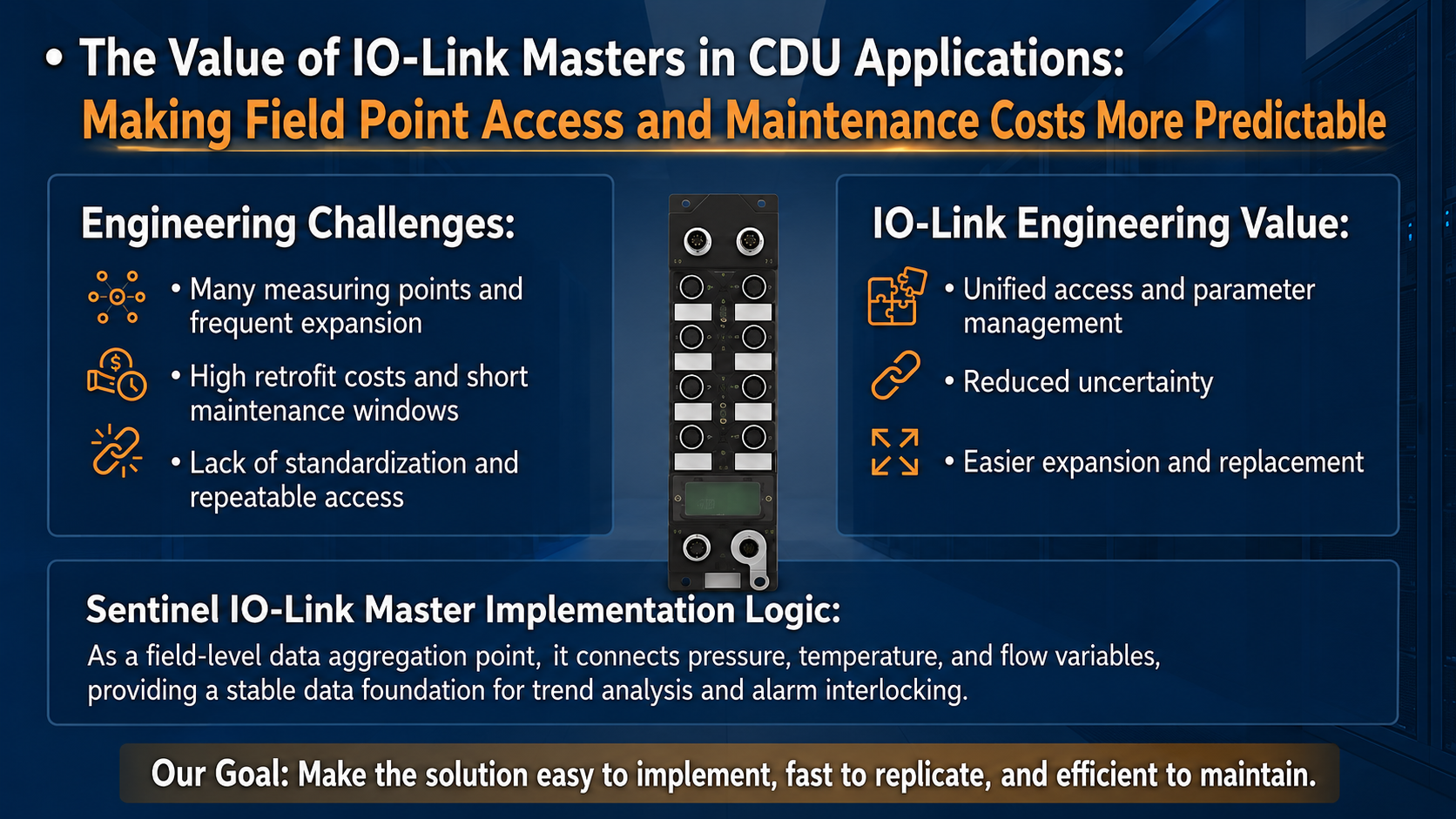
Data center projects have very practical engineering requirements: many measuring points, high retrofit costs, short maintenance windows, and frequent expansion. In many projects, the problem is not a lack of sensors, but the lack of a sufficiently standardized and repeatable data access method.
The engineering value of IO-Link lies in making unified access and parameter management easier at the field level. It reduces uncertainty caused by traditional wiring and signal chains, and it also makes later point expansion and device replacement more convenient.
Sentinel IO-Link masters can serve as field-level data collection points for CDU systems, bringing key variables such as pressure, temperature, and flow into the control system or monitoring system. This provides a more stable data foundation for trend analysis and alarm interlocking.
For projects that need fast implementation, key measuring points can be connected first, and trend and threshold logic can be verified before gradually expanding to more measuring points and more refined strategies according to the project schedule. Our goal is not to make the solution “look complete,” but to make it work in real engineering conditions, replicate quickly, and reduce maintenance effort.
From Solution to Implementation: Make Abnormalities Explainable and Maintenance Actionable
When a CDU is divided into several core areas, such as pump units, filters, heat exchangers, and distribution branches, the purpose of monitoring becomes clear: risks in each area should leave traces in the data.
When pump operation becomes abnormal, pressure and flow often show characteristic fluctuations, allowing the system to warn earlier that the loop is unstable. When a filter becomes progressively blocked, differential pressure rises slowly, allowing operation and maintenance teams to schedule maintenance before reaching the threshold, instead of waiting until insufficient flow forces passive intervention.
When heat exchange efficiency declines, the supply and return temperature difference trend changes. Operation and maintenance teams can use this information to check the heat exchanger condition and control strategy, instead of relying only on cabinet-side temperature alarms to guess the cause. When insufficient flow occurs in a key branch, the flow switch can directly trigger an interlock or alarm to prevent local risks from spreading.
The advantage of this method is that it is repeatable. It does not require a complex platform to create value. As long as key variables are collected reliably and threshold and trend logic are fixed as engineering templates, the method can be quickly replicated across more CDUs and more loops, gradually forming an operable liquid cooling maintenance system.
Summary
For CDU liquid cooling applications, Sentinel recommends building a basic monitoring loop with three key variables: pressure, temperature, and flow. Flow switches and vortex flow sensors can be combined to create a layered configuration of “protection + diagnosis,” while IO-Link masters provide more standardized data access and future expansion capability.
The value of this approach is practical and controllable. In the first stage, it can already bring clear benefits in stability and maintainability, while leaving room for more refined strategies and richer monitoring dimensions in the future.
If you are planning a new CDU project or a retrofit project, you are welcome to send us your loop structure, pump and filter configuration, key branch locations, and the alarm and interlock goals you want to achieve. Based on our existing product line, we can provide measuring point recommendations, selection ideas, and data access solutions, and support you in running the first replicable CDU monitoring sample.
FAQ
1. If the CDU already has temperature alarms, why are pressure and flow still needed?
Temperature is more like a result indicator. It can tell you that cooling has a problem, but it is difficult to explain where the problem comes from. Pressure reflects loop resistance and pump operating conditions, while flow proves whether coolant is being delivered stably. When all three are combined, abnormalities become easier to locate and maintenance actions become more actionable. Many risks can be moved from “troubleshooting after alarms” to “early detection through trends.”
2. How should flow switches and vortex flow sensors be used in CDU systems?
Flow switches are more suitable for threshold protection and interlock conditions in key branches. Their purpose is to quickly intercept the risk of local insufficient flow. Vortex flow sensors are more suitable for continuous measurement in the main loop or key metering sections, supporting trend warning, energy efficiency evaluation, and abnormality location. The two devices correspond to “protection” and “diagnosis” respectively, and using them together is more aligned with real CDU operation and maintenance needs.
3. What direct engineering benefits does IO-Link master access provide?
The biggest benefits are standardization and repeatability. A unified access method helps shorten commissioning time, reduce point-to-point wiring costs, and simplify later expansion and device replacement. This allows CDU systems to maintain predictable engineering cycles and maintenance costs during expansion and iteration, while also providing a more stable data foundation for trend analysis and alarm interlocking.
Customer Support and Service
Tianjin Sentinel Electronic has been deeply engaged in the industrial automation field for 17 years and has provided more than 170 application cases for industries such as rail transit, automotive manufacturing, and new energy. We provide full-cycle services from sensor selection and system integration to after-sales diagnosis. If you would like to learn more about Sentinel products, please contact our sales team or call us at 022-83726972. You can also visit Sentinel’s official website at www.sentinel-china.com.
You are welcome to schedule an online demonstration or apply for a sample trial, and let our engineers customize a complete solution for you from “data entry” to “action execution.”