Introduction
Many customers say when making an inquiry: “I need an M12 connector,” “Do you have field-wireable connectors?” or “I need an Ethernet communication cable.” It sounds like a small accessory requirement, but in industrial sites, this “connector” is often related to signals, power, communication, installation environments, and later maintenance. The real issue may not be buying a single connector, but matching, completing, and stabilizing the connection relationship between devices.
Why You Should Not Select Connectors Based Only on Appearance
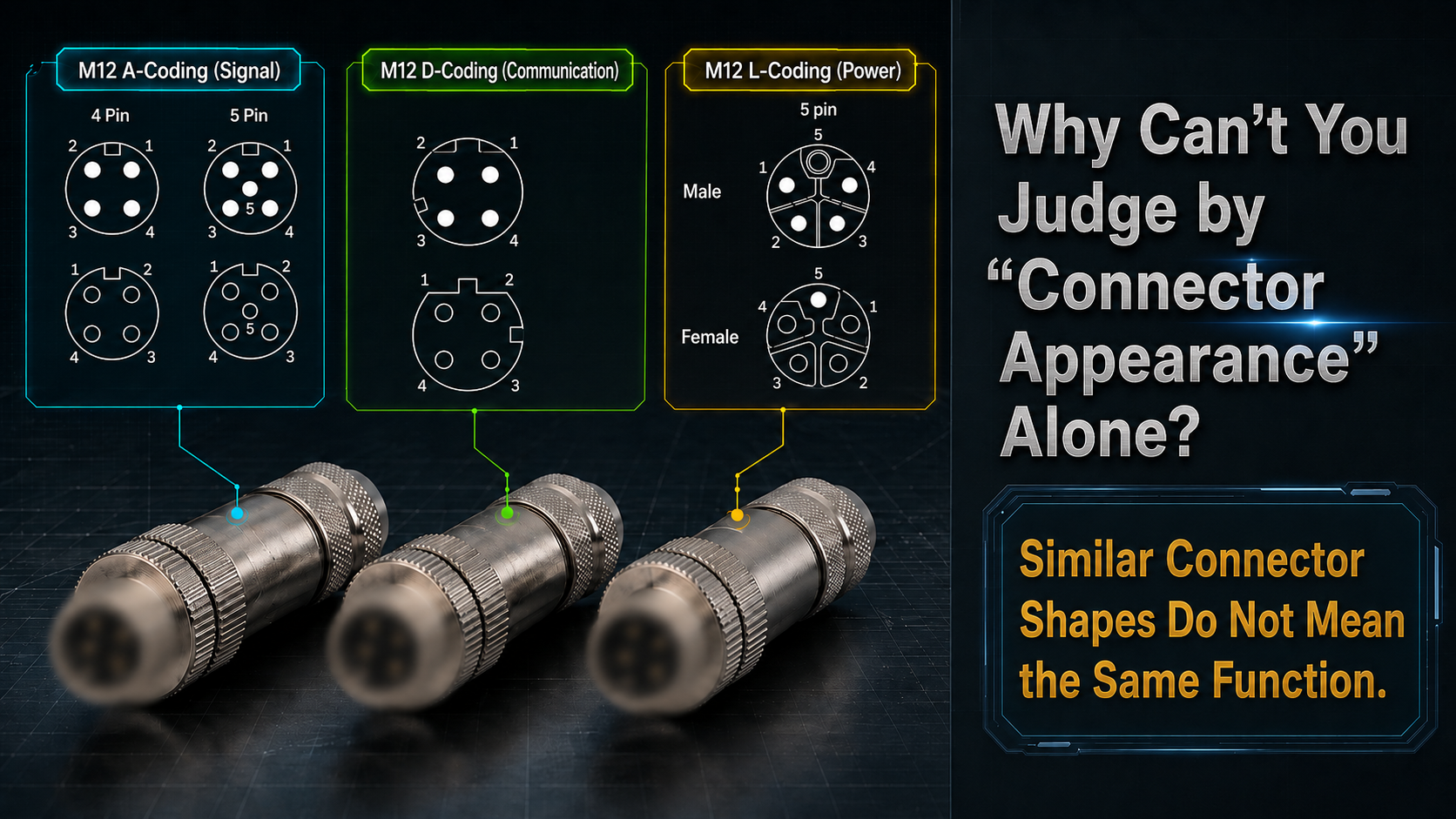
Industrial connectors share a common feature: they may look similar, but their functions can be completely different. This is especially true for circular connectors such as M8 and M12. Many of them use threaded locking structures and look similar, so on-site personnel often refer to them simply as “connectors.” However, from a system perspective, they serve different functions.
Taking M12 interfaces as an example, M12 A-coded connectors are commonly used for sensors, actuators, and general I/O signal connections; M12 D-coded connectors are often used for industrial Ethernet communication; M12 L-coded connectors are mainly used for power connection of field devices. Although they are all M12, if you only look at the size and ignore the coding type and function, problems such as “it can be plugged in but cannot work” or “the interface does not match” may easily occur.
For example, RJ45 is commonly used inside control cabinets, switches, and PLC sides, while M12 D-coded connectors are more often found on field modules, remote I/O, and IO-Link masters. 7/8″ connectors are commonly used for module power supply. They are all part of the connection system, but their transmission objects, installation positions, and application environments are different.
“Key Point
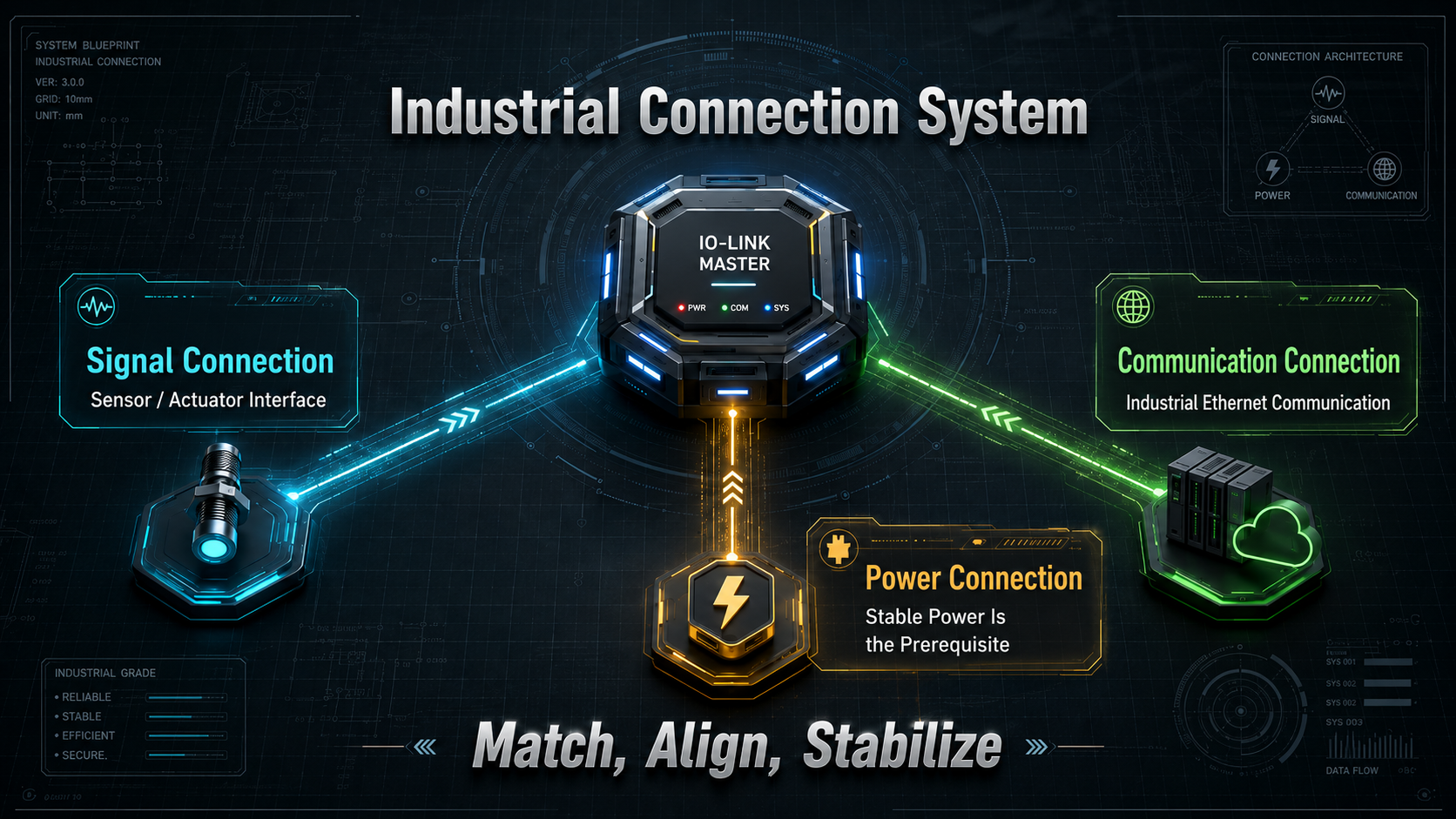
Signal Connection: How Sensors and Actuators Are Connected to the System
Signal connection mainly solves the connection between field sensors, actuators, and I/O modules. Pressure sensors, temperature sensors, level sensors, and flow sensors connected to the control system, as well as solenoid valves, indicator lights, relays, and other actuators connected to output modules, all belong to signal connection scenarios.
In these scenarios, customers need to pay attention not only to the “connector size,” but also to the number of pins, coding type, output type, cable length, installation space, and protection requirements. For example, whether a sensor uses switching output, analog output, or IO-Link communication may result in different connection methods and module interfaces.
M8 connectors, M12 A-coded connectors, sensor cables, IO-Link device cables, junction boxes, remote I/O modules, and IO-Link masters usually form a complete signal access chain together. For machine builders, the stability of signal connection directly affects commissioning efficiency and later troubleshooting efficiency.
Power Connection: Stable Power Supply Is the Basis of Stable Communication
Many on-site problems may appear to be communication failures, but the real cause may be unstable power connection. Remote I/O modules, IO-Link masters, sensors, and actuators all require reliable power supply. Once power contact is poor, current capacity is insufficient, or wiring is not standardized, problems such as device disconnection, abnormal output, and unstable sensor readings may occur on site.
Power connection usually involves 7/8″ power connectors, M12 L-coded power cables, power input cables, and power output cables. For multi-module daisy-chain connections, distributed field installation, and equipment with many actuator loads, power connection must not be treated as an accessory issue.
In a complete connection solution, power connection should be considered together with communication connection and signal connection. Even if the communication cable is selected correctly, an unstable module power supply will still make the system difficult to operate reliably. Therefore, when evaluating a connection solution, you should not only ask “how to connect communication,” but also confirm “how the device is powered.”
Communication Connection: Industrial Ethernet Is Not Just an Ordinary Network Cable
Customers often say, “I need a network cable,” but industrial Ethernet communication connection is not only about matching the interface. PLC to remote I/O, PLC to IO-Link master, switch to field module, and control cabinet RJ45 interface to field M12 D-coded interface all require suitable communication cables according to the field environment.
In industrial Ethernet applications such as PROFINET, EtherNet/IP, and EtherCAT, communication connection needs to consider cable class, shielding performance, anti-interference capability, bending environment, protection requirements, and interface type. RJ45 can be used inside the control cabinet, but outside the equipment and near field modules, M12 D-coded connectors are often more suitable for industrial environments.
RJ45 communication cables, M12 D-coded communication cables, RJ45 to M12 D-coded cables, double-ended M12 D-coded cables, and industrial Ethernet field-wireable connectors are common parts of a communication link. A truly reliable communication connection is not only about “plugging it in and seeing the light on,” but also about maintaining stable operation over the long term.
Pre-Molded Cables and Field-Wireable Connectors Are Suitable for Different Scenarios
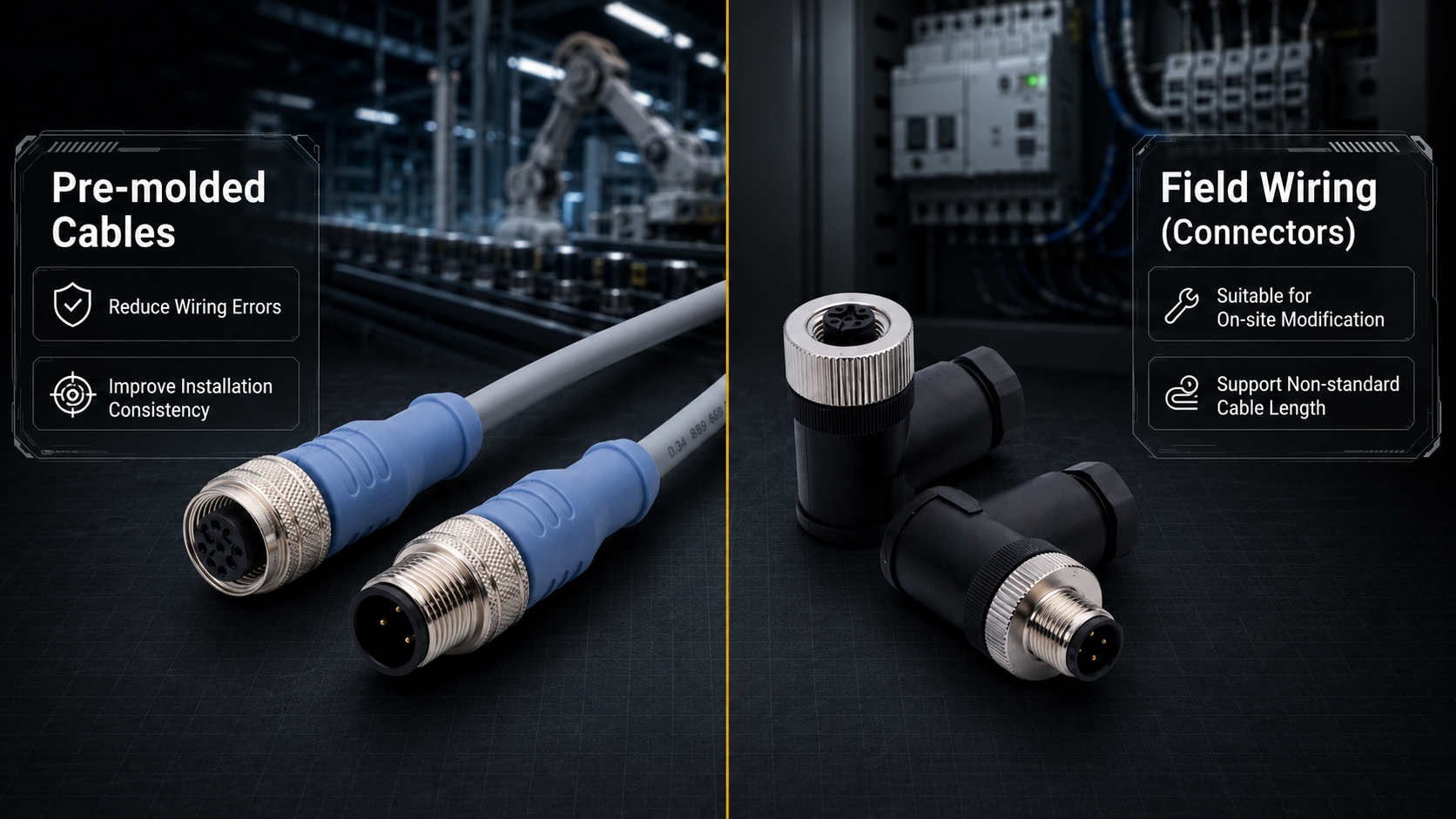
In addition to function, connectors also need to be selected according to the installation method. Pre-molded cables are finished cable assemblies in which the connector and cable have already been processed. They are suitable for mass production equipment, fixed interface positions, confirmed cable lengths, and scenarios where secondary wiring on site is not desired. Their value lies in reducing wiring errors and improving installation consistency and long-term stability.
For machine builders, pre-molded M8 cables, pre-molded M12 cables, pre-molded 7/8″ power cables, single-ended cables, double-ended cables, and Y-splitters can make equipment assembly more standardized and later maintenance easier. Especially for mass-produced equipment, consistency is often more important than temporary flexibility.
The “field-wireable connector” often mentioned by customers usually refers to a connector that can be wired on site. It is more suitable for field retrofit, equipment commissioning, maintenance replacement, non-standard wiring, and scenarios where the cable length is uncertain. Field-wireable connectors offer flexibility, but they require higher on-site wiring quality. Wire sequence, crimping, shielding, locking, sealing, and strain relief all need to be handled properly.
Therefore, a field-wireable connector is not a simple substitute for a pre-molded cable, but a suitable solution for flexible field wiring. Where it is used, who will perform the wiring, and whether reliable construction conditions are available should all be evaluated in advance.
From a Single Connector to a Complete Connection Solution
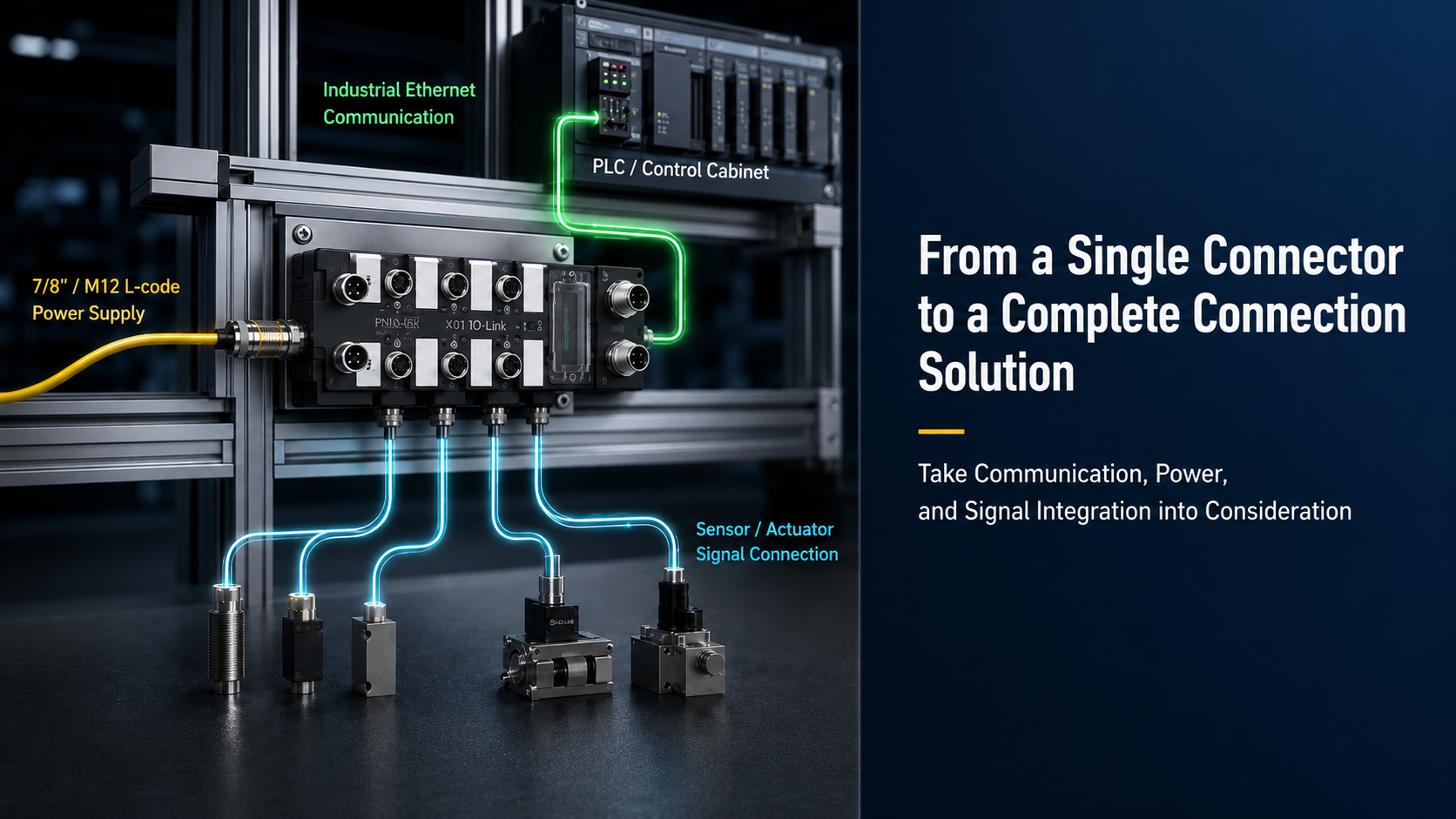
If an IO-Link master is installed in the field, it needs to communicate upward with the PLC, connect downward to multiple IO-Link hubs, and also require stable power supply. In this case, what the customer really needs is not a single connector, but a complete connection solution.
PLC to IO-Link master requires an industrial Ethernet communication cable; control cabinet RJ45 to field M12 D-coded interface requires an RJ45 to M12 D-coded cable; IO-Link master power supply requires 7/8″ or M12 L-coded power connection; IO-Link master to IO-Link hub requires an M12 A-coded cable; and IO-Link hub to sensors and actuators requires suitable connection cables or distributors according to the interface type.
At this point, a connection solution is not simply putting several connectors together. It requires unified consideration of communication, power, signals, field installation, and later maintenance. Whether the cable length is confirmed, whether quick replacement is required on site, and whether the equipment is for mass production or temporary retrofit will all affect the final selection.
Why Customers Often Mix These Concepts Together
Customers mix these concepts together not because they are unprofessional, but because industrial sites naturally use many different terms. Some customers call M12 connectors “connectors,” call field-wireable connectors “wireable connectors,” call industrial Ethernet cables “network cables,” and put adapter cables and extension cables into the general category of connection components.
On the other hand, many interfaces do look similar. Circular interfaces, threaded locking structures, and M8 or M12 specifications are shared features that can easily make people overlook the differences in coding type and function. At the early stage of a project, the customer may only see that “one connection component is missing,” but when the project is implemented, they still need to deal with power, communication, signals, protection, cable length, interference, maintenance, and many other issues.
Therefore, customers can describe their needs in simple terms, but suppliers cannot understand them only literally. A truly capable supplier should be able to identify the complete connection chain behind the phrase “I need a connector.”
Sentinel’s Value Lies in Field Connection Support
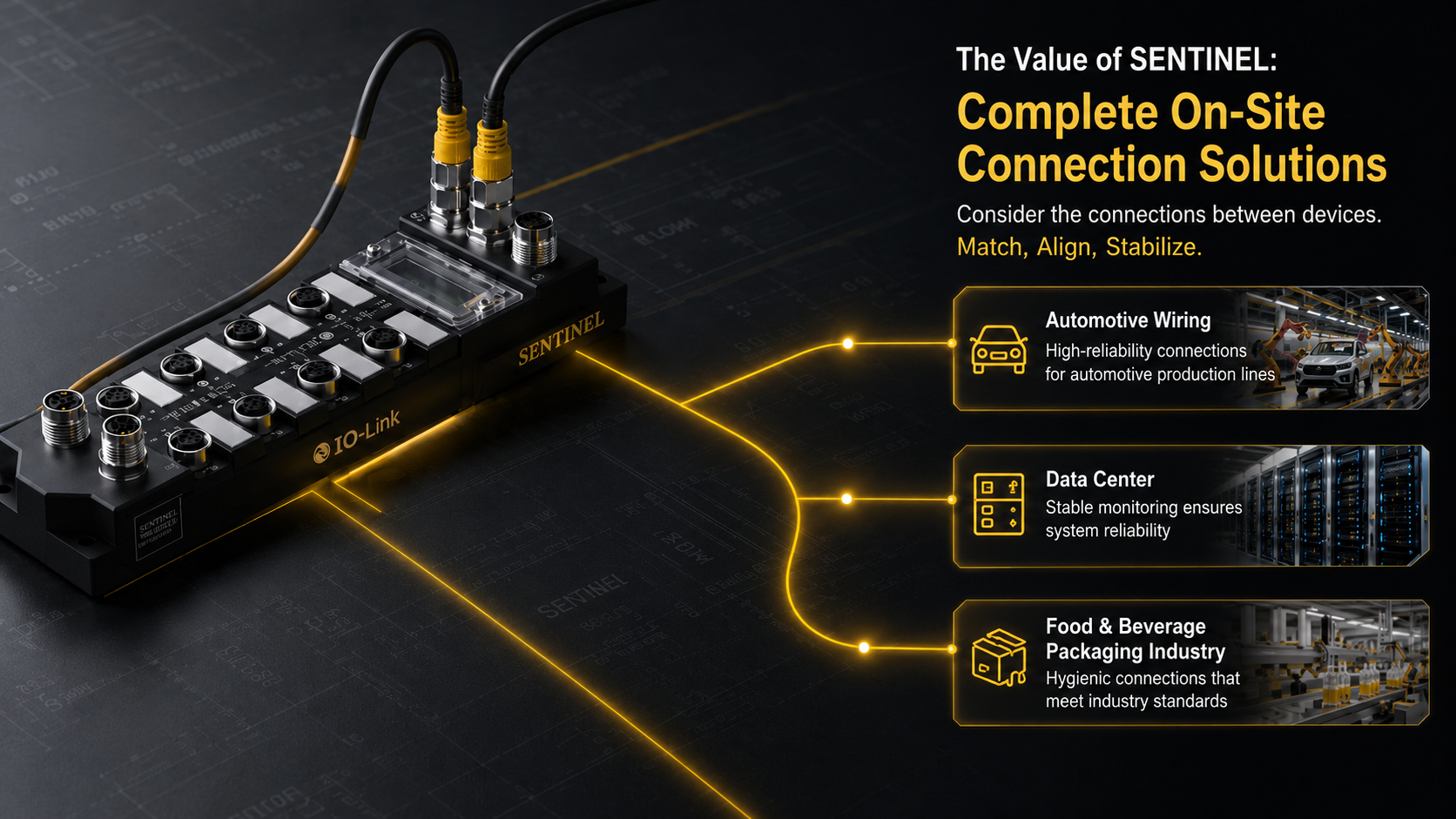
Sentinel’s product system covers multiple parts of the field connection chain. We provide IO-Link masters and remote I/O modules, so we understand module-side interfaces and field communication requirements. We also provide pressure, temperature, level, and flow sensors, so we understand field device signal access requirements.
At the same time, Sentinel provides M8/M12 connectors, industrial Ethernet communication cables, power connectors, and other connection products, enabling complete support around field devices. Customers do not necessarily need to know all model numbers from the beginning. As long as the device interface, connection object, communication method, cable length, and installation environment are clear, it is possible to further determine whether to use pre-molded cables or field-wireable connectors, and whether to use M12 A-coded, M12 D-coded, or power connectors.
True connection solution capability is not about selling products from a catalog, but about helping customers match, complete, and stabilize the connection relationship between devices. For field-level equipment, this capability often determines whether system installation goes smoothly and whether later maintenance is efficient.
Before Selecting Connectors, Clarify the Key Questions First
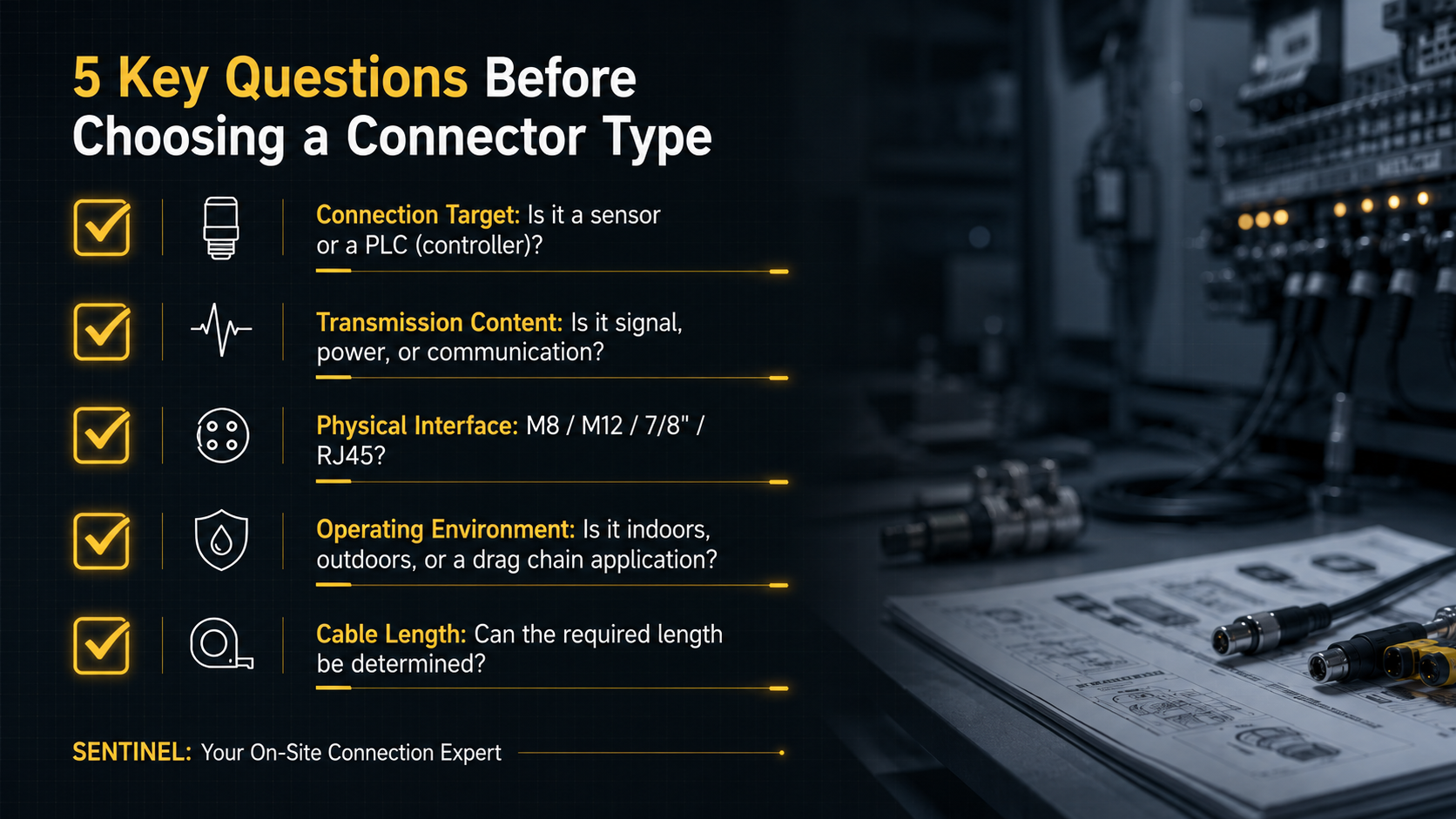
Before selecting connectors, it is recommended to clarify several key questions first: Is the connection object a sensor, actuator, remote I/O, IO-Link master, or PLC? Does this cable mainly transmit signals, power, or Ethernet communication? Is the interface M8, M12 A-coded, M12 D-coded, M12 L-coded, 7/8″, or RJ45? Will it be used inside the control cabinet or in an external IP67 field environment? Has the cable length been confirmed? Is the application for standardized use in mass-produced equipment or for temporary field retrofit? Are there oil stains, moisture, vibration, drag-chain movement, or electromagnetic interference on site?
These questions may seem basic, but they determine whether the connection solution will be reliable. Connectors are not isolated small accessories. They are part of the stable operation of field devices. Only by clarifying the connection chain can repeated confirmation during commissioning be reduced and uncertainty in later maintenance be lowered.
▣Article Summary
What customers seem to buy is a connector, but what the site really needs to solve is how to stably connect signals, power, and communication between devices. Different interfaces serve different functions. M12 A-coded, M12 D-coded, M12 L-coded, RJ45, and 7/8″ connectors cannot be judged only by appearance.
If you only know that the site “needs a connector,” you can also send us the device interface, site photos, cable length, and connection object first. Sentinel can help you determine the connection type first, and then provide suitable connectors, cables, and connection solutions.
FAQ
1. Are all M12 connectors interchangeable?
They cannot be simply used interchangeably. M12 is only an interface specification. In actual applications, coding types such as A-coded, D-coded, and L-coded must also be distinguished. A-coded connectors are mostly used for sensors and I/O signal connections, D-coded connectors are mostly used for industrial Ethernet communication, and L-coded connectors are mostly used for power connection. Different coding types and functions mean they cannot be treated as the same product only based on appearance.
2. When should pre-molded cables be used, and when should field-wireable connectors be used?
If the equipment is mass-produced, the interface position is fixed, and the cable length is confirmed, pre-molded cables are usually more suitable because they offer better installation consistency and lower wiring risk. If it is for field retrofit, maintenance replacement, commissioning, or when the cable length is uncertain, field-wireable connectors are more flexible, but on-site wiring quality must be ensured.
3. Why should a connection solution consider signals, power, and communication at the same time?
Field devices operate as a complete system. Even if the communication cable is selected correctly, unstable power supply may still cause device disconnection. Even if the sensor interface is connected correctly, data cannot properly enter the system if the signal type does not match. Therefore, a connection solution must consider signals, power, communication, environment, and maintenance together to ensure long-term stable operation.
Customer Support and Service
Tianjin Sentinel Electronics has been deeply engaged in the industrial automation field for 17 years and has provided more than 170 application cases for industries such as rail transit, automotive manufacturing, and new energy. We provide full-cycle services from sensor selection and system integration to after-sales diagnostics. For more information about Sentinel products, please contact our sales team or call us at 022-83726972. You can also visit Sentinel’s official website www.sentinel-china.com.
You are welcome to schedule an online demonstration or apply for a sample trial, and our engineers will customize a complete solution for you, from "data input" to "action execution."