Introduction
When many customers choose a cooling water temperature sensor, the first question is often: “What is the temperature range?” They then continue to confirm accuracy, output signal, whether 4–20 mA is available, and whether IO-Link is supported. These questions are certainly important, but in real field applications, a temperature sensor is not necessarily easy to use just because its parameters meet the requirements. Pipe size, installation method, medium type, signal access method, and later maintenance habits will all affect the final selection result.
When Selecting a Temperature Sensor, the First Step Is Not to Look at the Model, but at the Field Conditions
Cooling water, coolant, circulating water, and equipment cooling circuits all seem to involve liquid temperature measurement, but their corresponding field conditions are not exactly the same. Some systems only need to determine whether the temperature is too high, some systems need to continuously collect temperature changes, and some equipment also needs to connect temperature data to a PLC, remote I/O, or IO-Link master for centralized monitoring and maintenance.
“Key Point
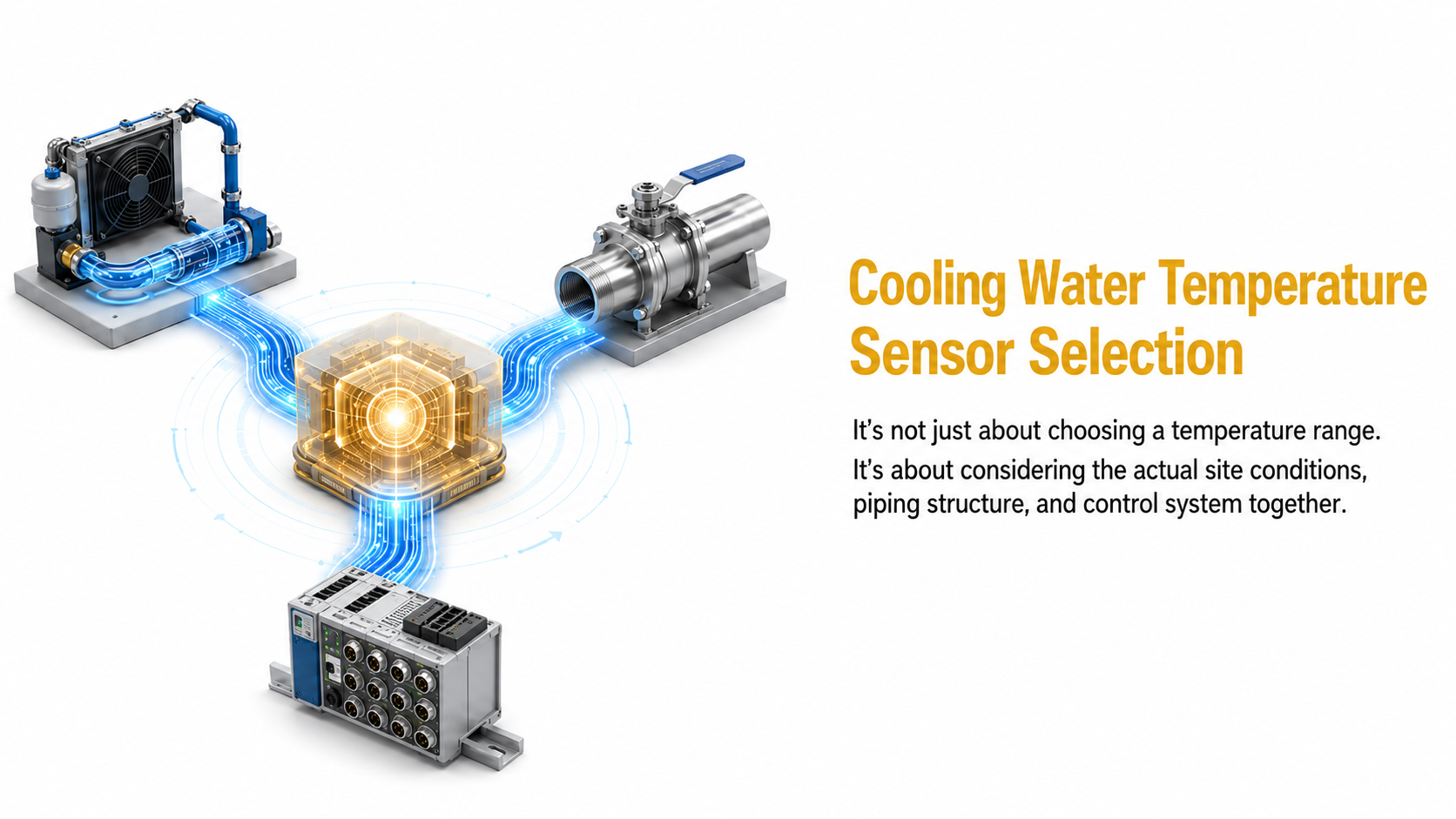
The selection of a cooling water temperature sensor is not simply about choosing a temperature range. Field conditions, pipeline structure, and the control system must be considered together.
Confirm What Is Being Measured First, Then Confirm the Temperature Range
In cooling systems, temperature sensors are usually used to monitor the operating status of cooling water or coolant. For ordinary equipment cooling circuits, the normal temperature may not be very high, but the field still needs to pay attention to temperature fluctuations, heating trends, and abnormal alarms. For example, changes in equipment operating load, pump group status, filter blockage, or decreased heat exchange efficiency may all be reflected in temperature changes.
If only over-temperature alarm is required, the switching output of the sensor can meet basic needs. If the customer wants to see the trend of temperature changes, analog output will be more suitable. If the field requires unified parameter modification, status reading, or device identification later, IO-Link will be more valuable.
Therefore, range is only a basic judgment. What truly determines the selection direction is what role the field expects the sensor to play: an alarm point, a continuous data acquisition point, or a data node in cooling system status monitoring.
The Installation Method Cannot Be Decided Arbitrarily, and Pipe Diameter Will Affect the Solution
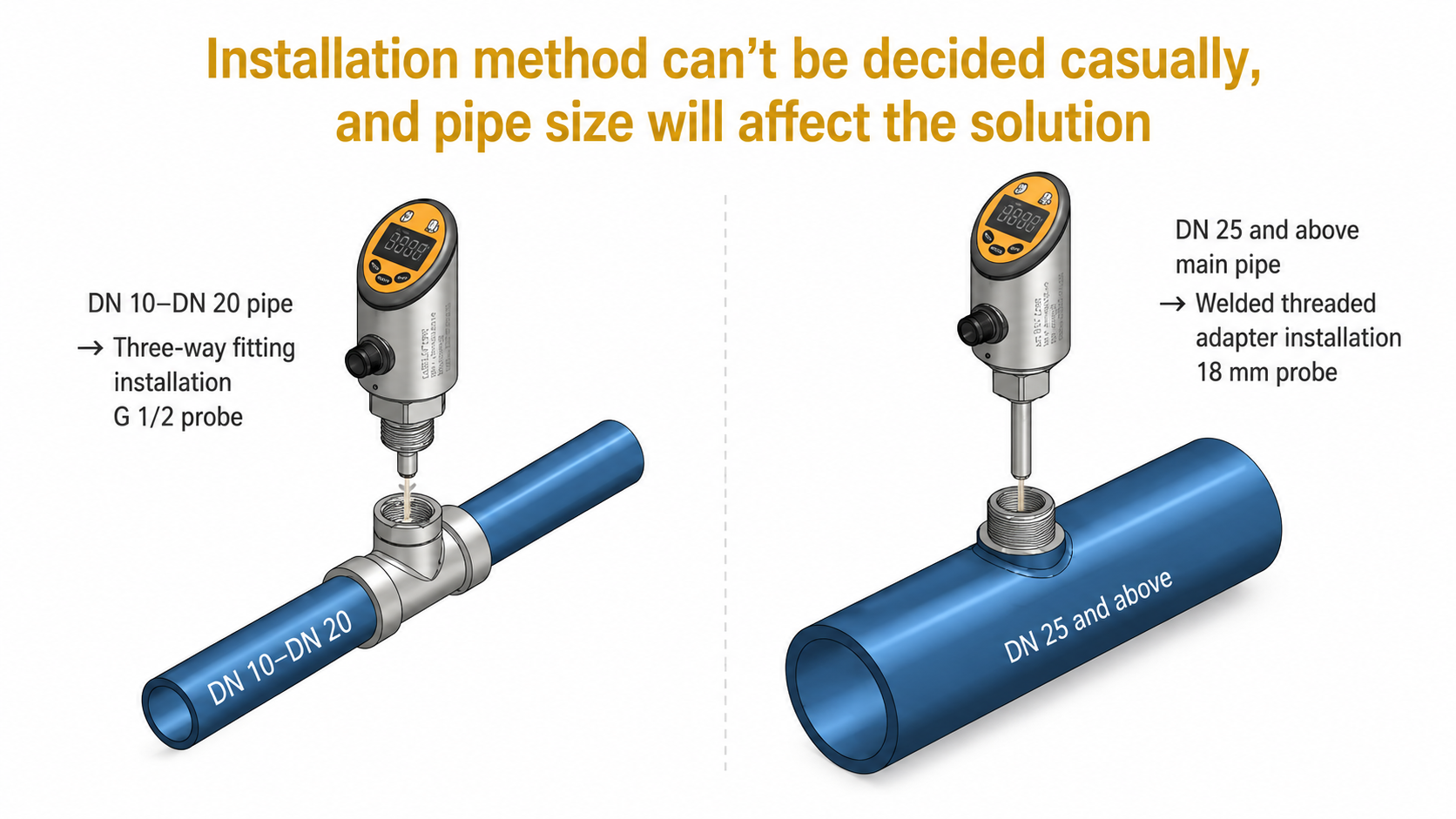
After the temperature sensor parameters are suitable, it is also necessary to check whether it can be correctly installed on the field pipeline. In cooling water systems, pipe diameter, pipeline structure, and field modification methods often directly affect the choice of probe type.
For small-diameter pipes such as DN 10–DN 20, customers can usually install the temperature sensor through a tee. In this case, choosing a G 1/2 probe is relatively common. The installation method is clear and is also convenient for field maintenance and replacement.
For pipes above DN 25, it is usually not suitable to simply install the sensor through a tee. A more reasonable approach is to weld an external threaded adapter onto the pipe and then install an 18 MN probe. This method is more suitable for large-diameter pipelines and better meets the requirements of field installation space and structural strength.
It should be emphasized here that G 1/2 and 18 MN are not isolated options to compare which one is better. Instead, they should be selected according to the field pipe diameter and installation conditions. The probe type is only part of the installation solution. What truly needs to be judged first is the pipe size, whether opening a hole is convenient, whether an adapter can be welded, and whether later disassembly and maintenance need to be convenient.
The Output Signal Determines How the Sensor Is Connected to the System
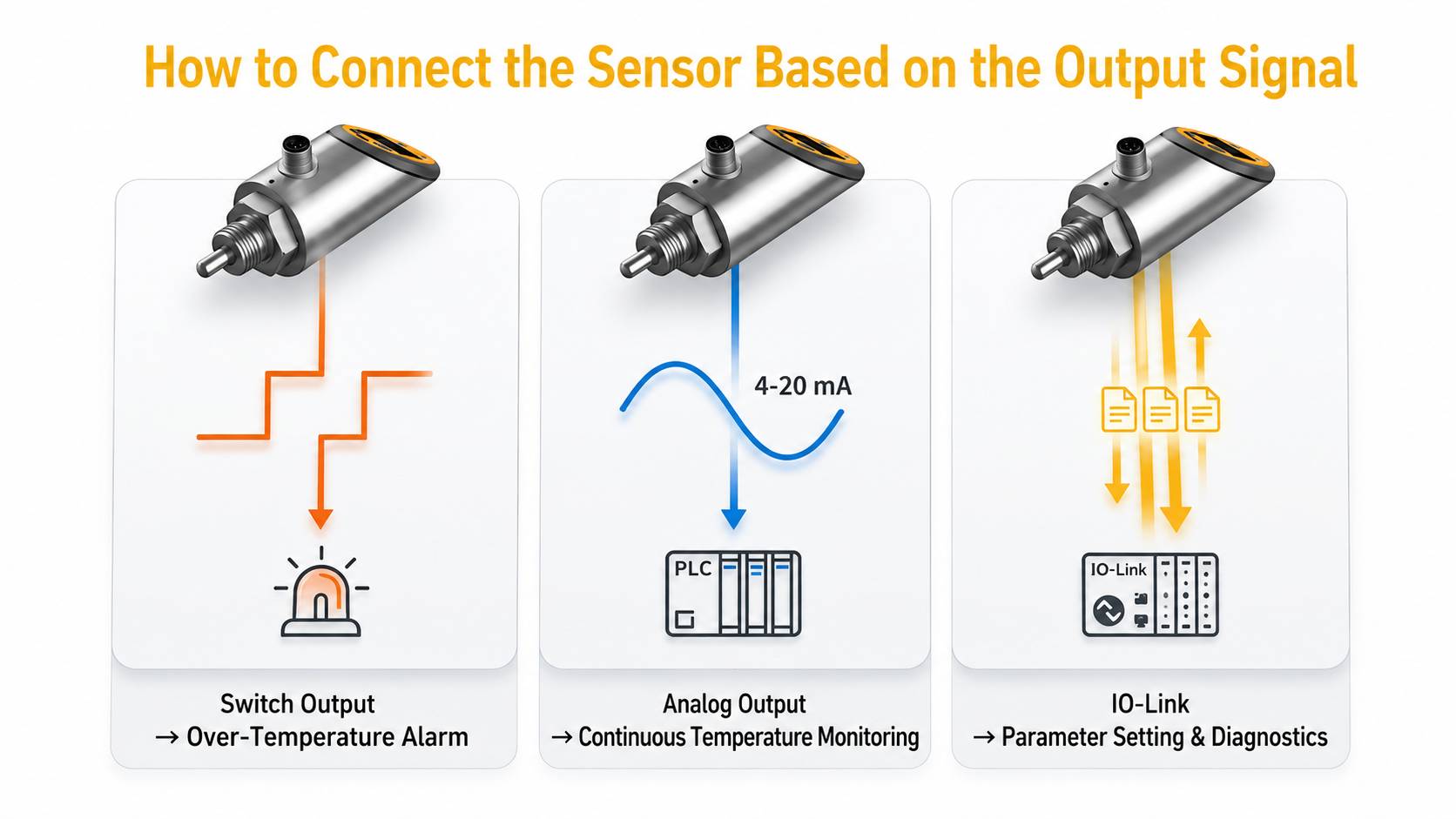
The installation method solves the question of “whether it can be installed,” while the output signal solves the question of “how it is connected to the system.” For cooling water temperature detection, common signal methods include analog, switching, and IO-Link.
4–20 mA or 0–10 V output is suitable for connection to PLC analog modules for continuous temperature acquisition. Customers can see real-time temperature changes in the control system and can also judge whether the cooling effect is stable based on temperature trends.
Switching output is suitable for over-temperature alarms, setpoint reminders, or simple interlock control. For example, when the temperature exceeds the set value, the sensor directly outputs an alarm signal to remind field personnel to check the cooling water circuit or equipment operating status.
IO-Link is more suitable for fields with higher requirements for equipment management. Through IO-Link, the sensor can not only transmit temperature data, but also perform parameter setting, status diagnosis, and device identification. For production lines that require unified maintenance, reduced on-site manual settings, and improved equipment transparency, IO-Link can turn a temperature sensor from a simple measuring element into a manageable field device.
A Good Temperature Sensor Should Also Be Easy to View and Maintain on Site
In many equipment sites, the installation position of the temperature sensor is not always ideal. Some are installed on the side of the pipeline, some inside the equipment, some in poorly lit positions, and some scenarios require operators to directly view the temperature value next to the equipment. Therefore, on-site display and setting convenience will also affect the user experience.
SENTINEL temperature sensors can provide LED display, button setting, normally open/normally closed setting, PNP/NPN/push-pull output, hysteresis/window functions, analog output, IO-Link, and other configurations according to field requirements. For equipment that requires on-site commissioning, operators can directly view the temperature status and adjust alarm points or output logic according to process requirements.
At the same time, the M 12 interface and stainless steel probe structure are also more suitable for industrial field installation and maintenance. For equipment manufacturers and system integrators, this type of structured design can reduce wiring complexity and improve later replacement and commissioning efficiency.
Cooling Systems Should Not Only Focus on Temperature; Pressure and Flow Are Also Critical
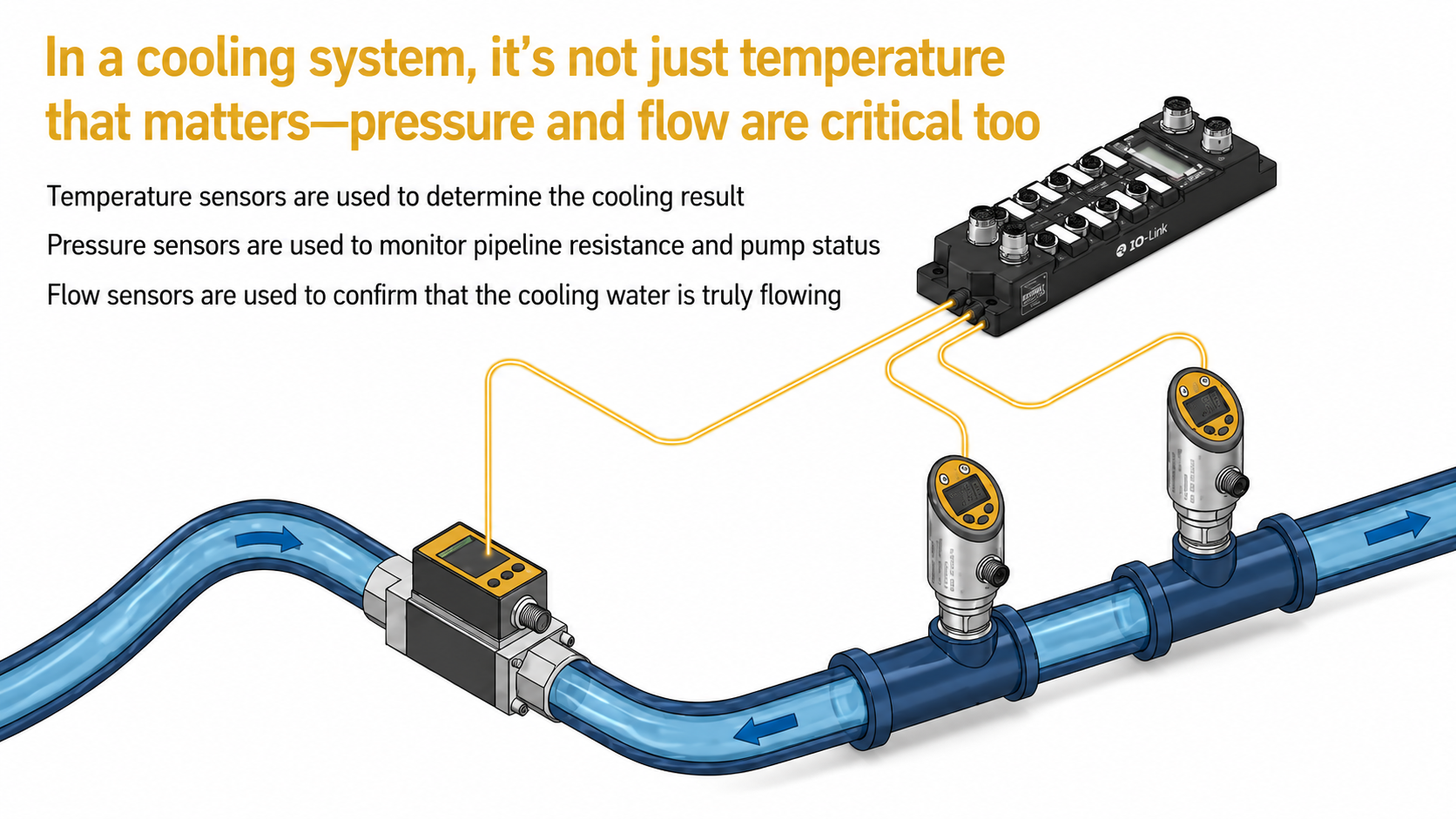
In cooling water systems, temperature is an important status indicator, but it is not the only indicator. If only temperature is considered, it may sometimes be impossible to fully determine whether the cooling system is normal. For example, a temperature rise may be caused by insufficient flow or decreased heat exchange efficiency; abnormal pressure may come from pipeline blockage, valve status changes, or abnormal pump-side operation; insufficient flow may reduce equipment cooling performance and even trigger subsequent alarms.
Therefore, on some equipment with higher stability requirements, temperature, pressure, and flow can be analyzed together. The temperature sensor is used to judge the cooling result, the pressure sensor is used to reflect pipeline resistance and pump-side status, and the flow sensor is used to confirm whether the cooling water is actually flowing properly. With the cooperation of these three types of signals, field personnel can make more accurate judgments about the cooling circuit.
SENTINEL can provide customers with a more complete field-level signal acquisition solution covering temperature sensors, pressure sensors, flow sensors, remote I/O modules, and IO-Link masters. In this way, customers receive not just a temperature measuring element, but a supporting approach that is closer to field control requirements.
When Selecting a Model, It Is Recommended to Clarify This Information First
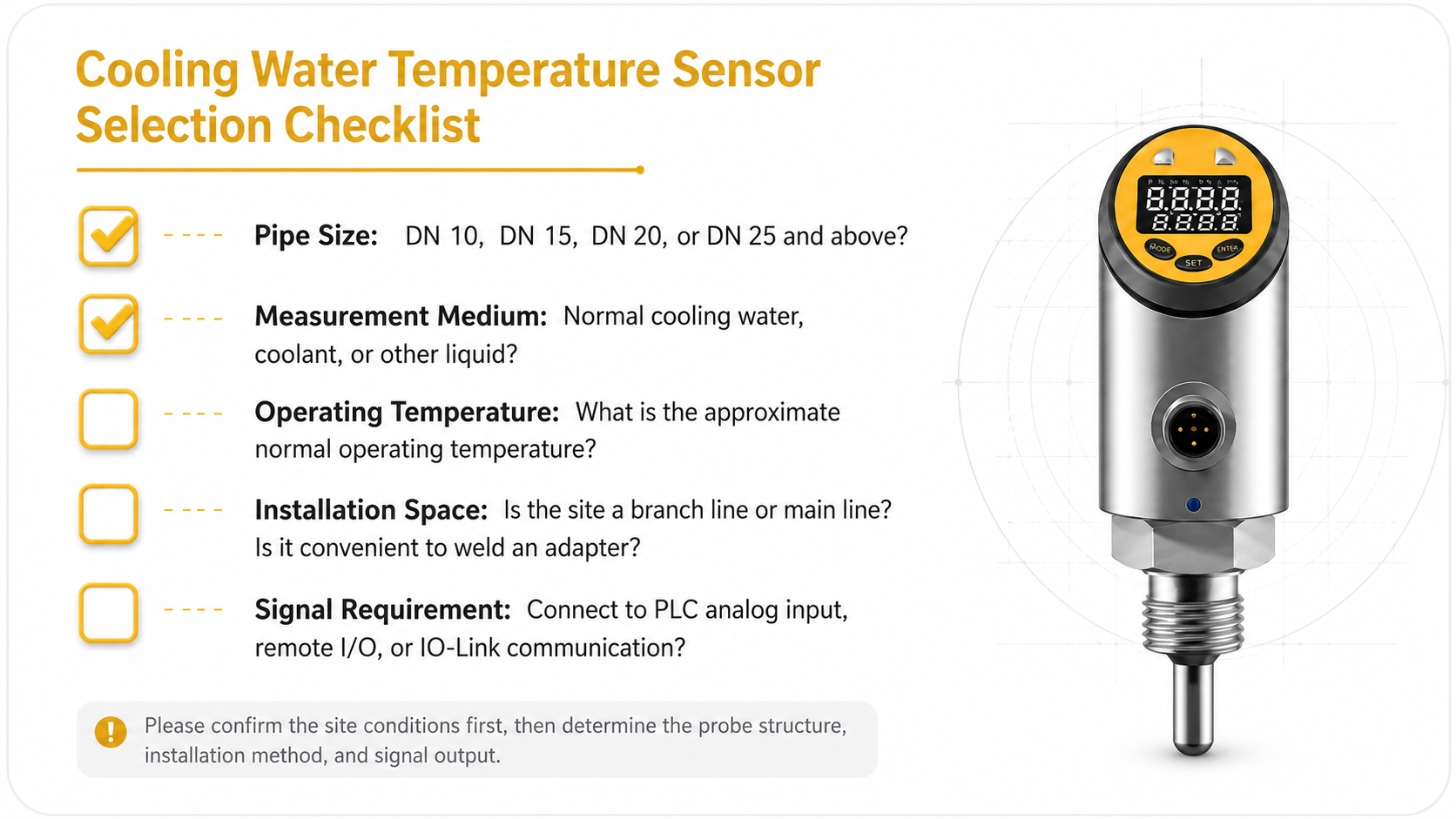
If you are not sure how to choose a cooling water temperature sensor, it is recommended to first confirm several key pieces of information: whether the pipe is DN 10, DN 15, DN 20, or above DN 25; whether the measured medium is ordinary cooling water, coolant, or another liquid; what the approximate normal operating temperature is; whether the site is a branch line or a main pipeline; whether installation through a tee is possible; and if it is a large-diameter pipe, whether it is convenient to weld an external threaded adapter.
At the same time, the signal access method also needs to be confirmed. Will the sensor be connected to a PLC analog module or to remote I/O? Is only switching alarm required, or is IO-Link communication needed? Does the field require temperature value display, button setting, or unified parameter modification later?
The clearer this information is, the more accurate the selection will be. When recommending temperature sensors to customers, SENTINEL will also give priority to field pipe diameter, installation method, output signal, and control system requirements, rather than selecting a model only according to the parameter table.
▣Article Summary
The selection of a cooling water temperature sensor cannot be based only on range. Temperature range, medium type, pipe size, installation method, output signal, and maintenance method will all affect the actual performance of the sensor in the field. A truly suitable product should not only meet measurement requirements, but also adapt to field installation and control system access.
For DN 10–DN 20 pipes, a G 1/2 probe can usually be selected in combination with tee installation. For pipes above DN 25, it is more suitable to install an 18 MN probe through a welded external threaded adapter. If linked monitoring of pressure, flow, and temperature is also required, a cooling circuit status monitoring solution can be further built to make field judgment clearer and maintenance more proactive.
FAQ
1. Why can’t the selection of a cooling water temperature sensor be based only on range?
Because range can only indicate whether the sensor has basic measurement capability. It cannot indicate whether the sensor is suitable for field installation, whether it is convenient to connect to the control system, or whether later maintenance will be convenient. Actual selection also requires comprehensive judgment based on medium type, pipe size, installation method, and output signal.
2. How should G 1/2 probes and 18 MN probes be understood?
G 1/2 and 18 MN mainly correspond to different installation solutions. Small-diameter pipes such as DN 10–DN 20 can usually be installed through a tee, making them suitable for G 1/2 probes. Pipes above DN 25 are usually not suitable for tee installation and are more suitable for installing an 18 MN probe after welding an external threaded adapter onto the pipe.
3. Why should pressure and flow also be considered in cooling water systems?
Temperature reflects the cooling result, but it cannot fully indicate whether the cooling circuit is normal. Flow can determine whether the cooling water is actually flowing properly, while pressure can reflect pipeline resistance and pump-side status. Considering temperature, pressure, and flow together makes it possible to judge the operating status of the cooling system more accurately.
Customer Support and Service
Tianjin SENTINEL Electronics has been deeply engaged in the industrial automation field for 17 years and has provided more than 170 application cases for industries such as rail transit, automotive manufacturing, and new energy. We provide full-cycle services from sensor selection and system integration to after-sales diagnosis. To learn more about SENTINEL products, please contact our sales staff or call the company at 022-83726972. You can also visit the SENTINEL official website at www.sentinel-china.com.
You are welcome to schedule an online demonstration or apply for a sample trial, and let our engineers customize a complete solution for you from "data entry" to "action implementation."