Introduction
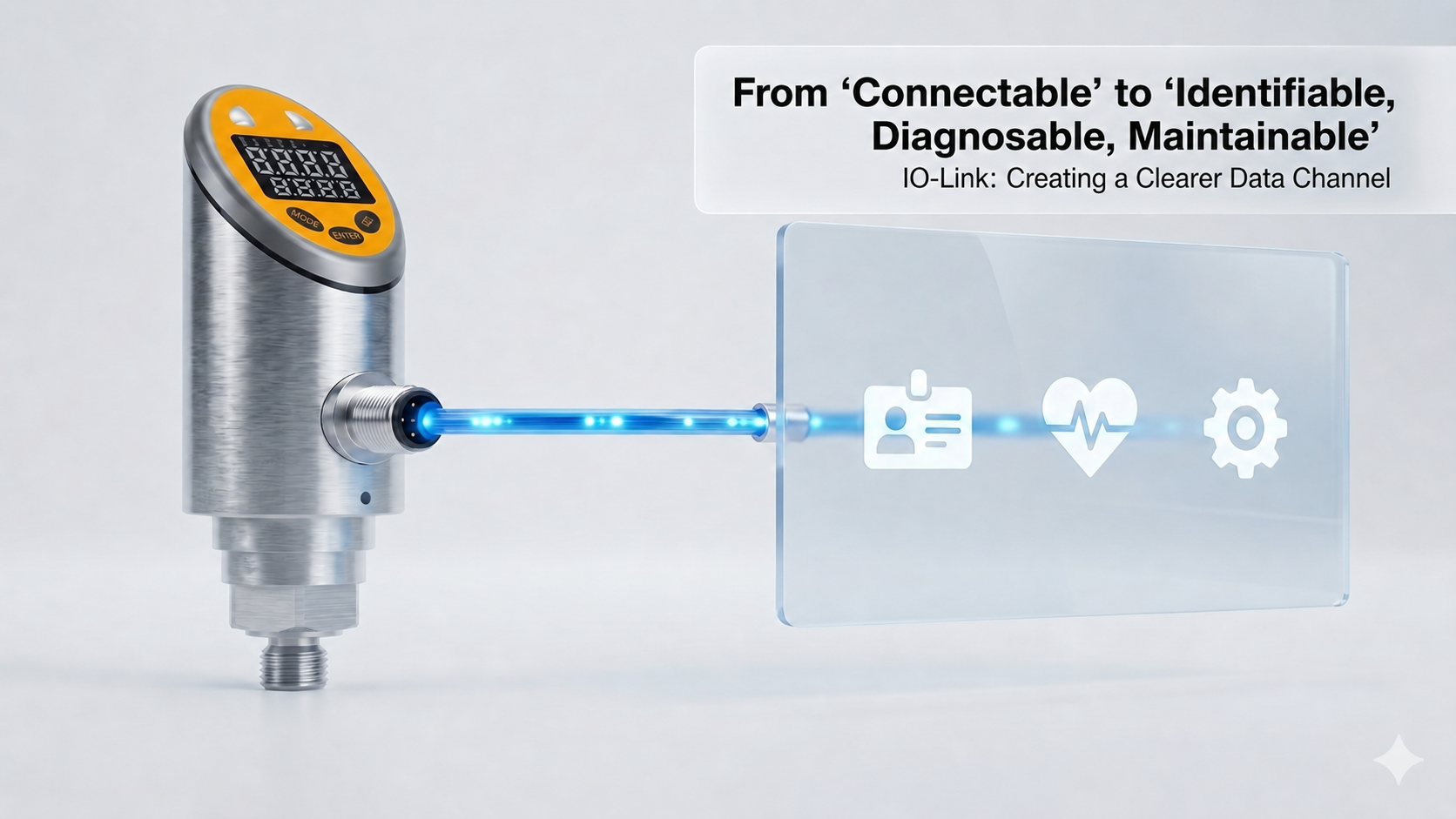
In the past, field devices only needed to “send a signal” and “be controlled.” Today, however, devices are expected to tell the system: “Who am I? What is my current status? Are my parameters correct? Are there any abnormal trends?”
The value of IO-Link lies in building a clearer data channel between traditional sensors and digital systems.
This article starts with a communication interface and explains why industrial field devices are moving from “connectable” to “identifiable, diagnosable, and maintainable.”
01 | Understanding the Digitalization Trend of Field Devices Through One Communication Interface
In the past, sensors and actuators on the factory floor only needed to do one thing: output a signal, or no signal. A digital signal or an analog signal was enough for basic control needs.
But as the number of devices increases, production cycles become faster, and production line changeovers become more frequent, field devices now need to “say” much more than before. This is one of the key reasons why IO-Link is receiving increasing attention.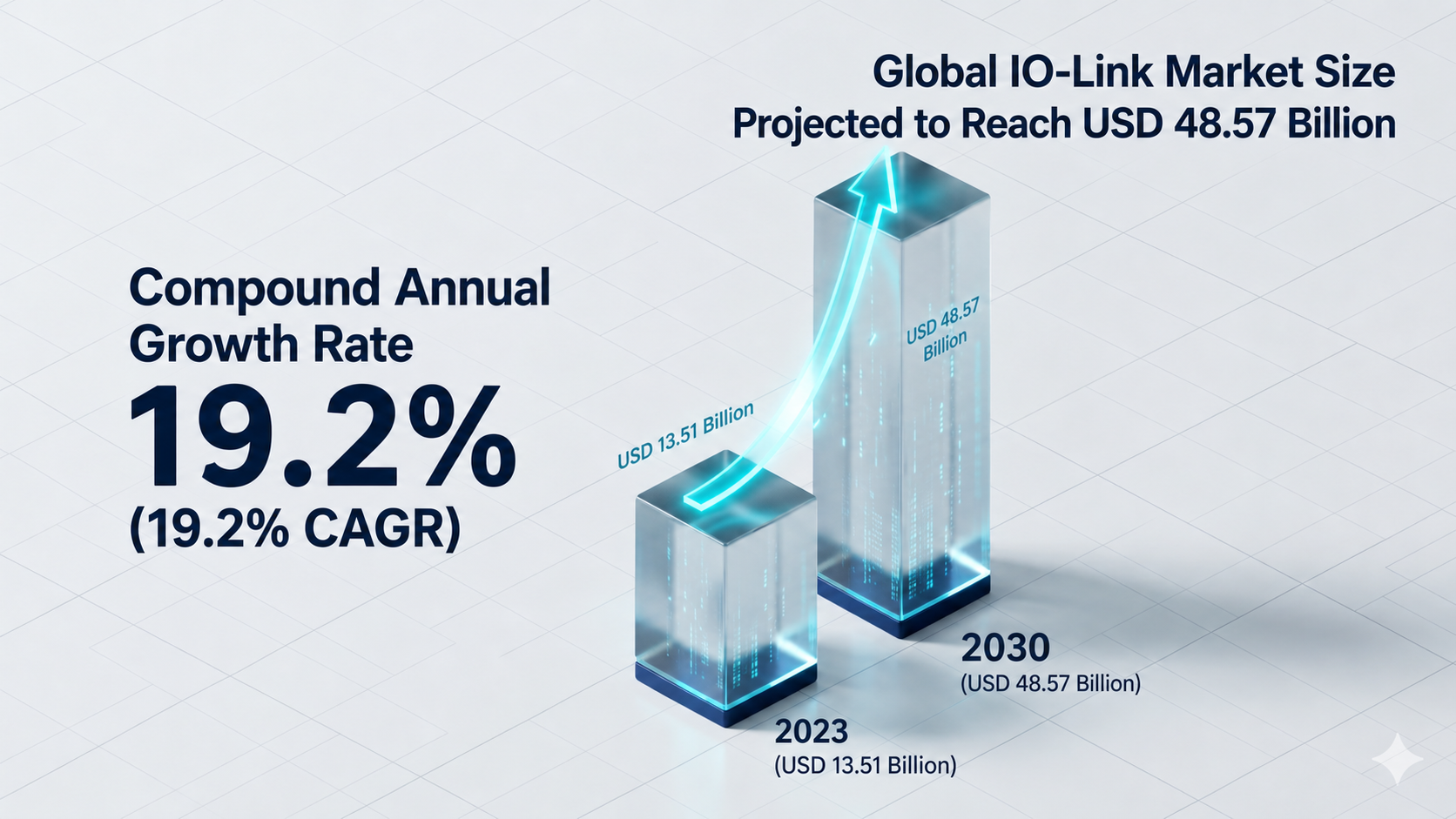
According to a market report by the third-party research organization Grand View Research, the global IO-Link market size was approximately USD 13.51 billion in 2023 and is expected to reach USD 48.57 billion by 2030, with a compound annual growth rate of about 19.2%.
Behind these numbers is not only the adoption of a communication technology, but also a broader shift in the factory field layer: from “being wired and controlled” to “being identifiable, diagnosable, and maintainable.”
02 | What Is IO-Link? First, Let’s Clear Up a Common Misunderstanding
To understand IO-Link, it is important to first avoid a common misunderstanding: IO-Link is not a traditional fieldbus.
Traditional fieldbus systems, such as PROFIBUS, often require complex network topologies and sometimes dedicated cables. IO-Link is different. It is based on the traditional three-wire sensor wiring method. There is no need to replace cables or change existing wiring habits. Instead, IO-Link adds bidirectional digital communication capability to the original interface.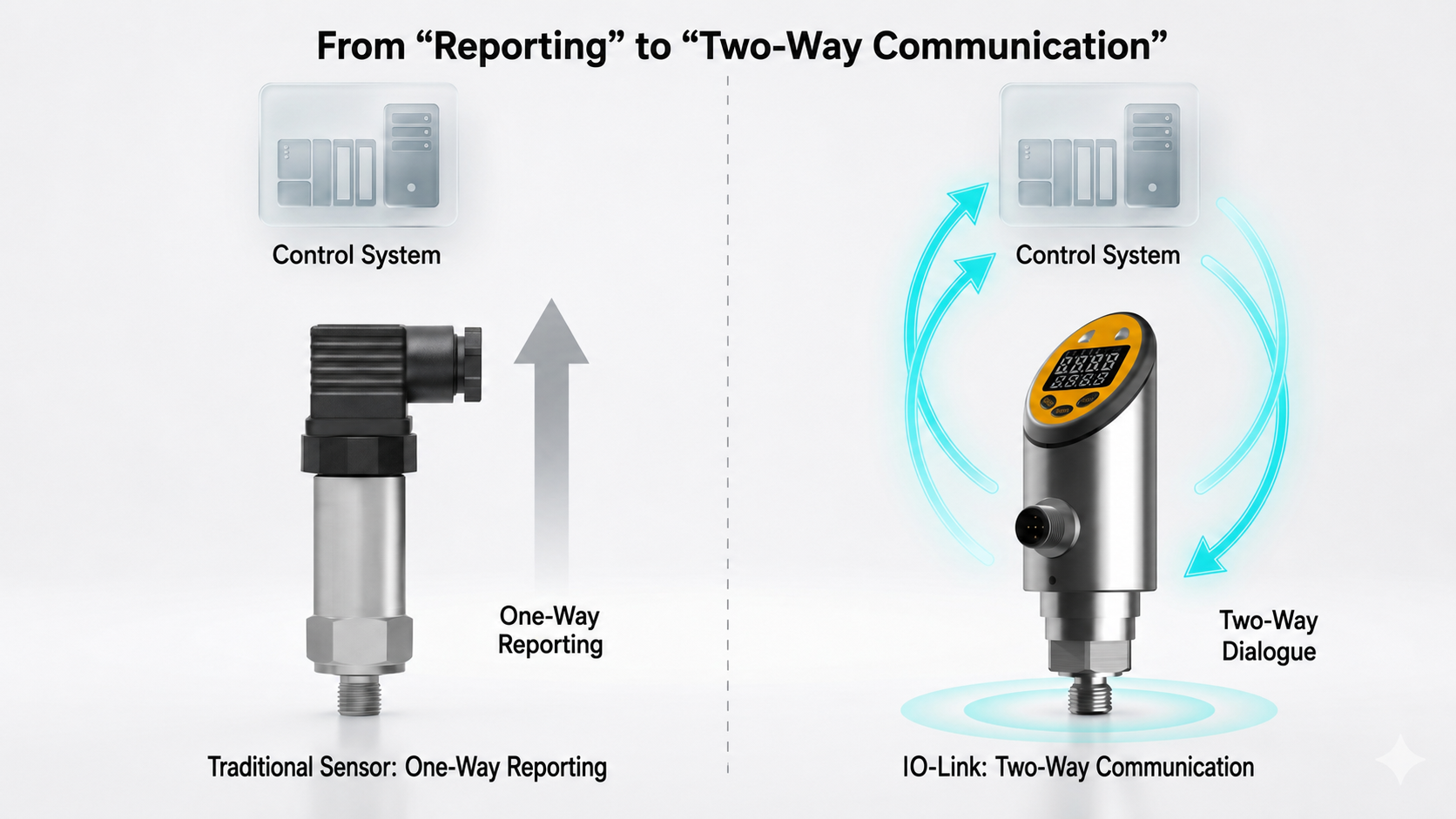
To put it simply, a traditional sensor is like a one-way street: signals can only be sent upward from the field. An IO-Link sensor is more like a two-way channel: the control system can send configuration commands downward, while the device can report status information upward. In this way, the system and the device can truly “communicate.”
IO-Link is an I/O technology compliant with the IEC 61131-9 international standard. It does not require an additional dedicated network. Based on the original point-to-point wiring and combined with an IO-Link master, each device can gain four key capabilities: device identification, parameter management, process data transmission, and diagnostic information.
What does this mean for the field? It means you no longer only know whether a sensor has a signal. You can also know which sensor it is, whether the parameters are set correctly, and whether there are any potential fault trends.
03 | Why Field Devices Need to “Speak”
Let’s look at a few typical scenarios:
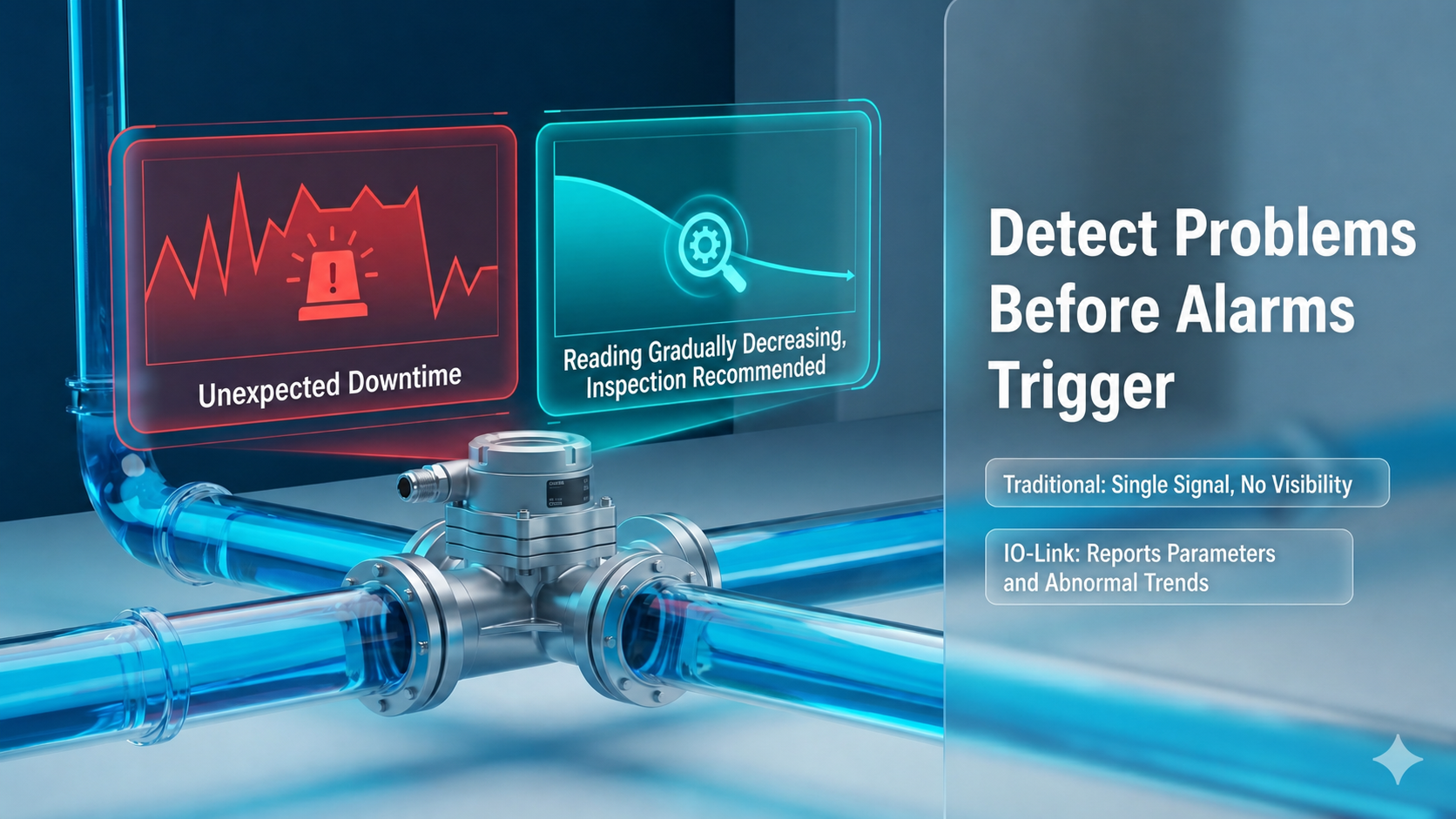
In a liquid cooling system, if the flow sensor value starts to drop slowly, it may indicate filter blockage or pump operating deviation. But if the device only outputs a simple “flow/no flow” switching signal, this early change cannot be detected at all.
If pressure sensor fluctuations become larger, it may be caused by air bubbles in the pipeline, leakage, or load changes. However, a single analog signal alone cannot clearly identify the cause.
If a sensor stays outside the normal range for a long time, it may be due to installation deviation, environmental interference, or device aging. But if the system never receives any status information, the problem can easily remain hidden.
If these devices can “speak” — reporting their own status, contamination level, operating parameters, and abnormal trends in real time — many problems can be discovered and handled before alarms are triggered.
Maintenance can shift from passive response to proactive management, and the risk of downtime can be greatly reduced.
This is exactly the core value of IO-Link. In its materials related to the Industrial Internet of Things, the IO-Link Community points out that intelligent IO-Link devices can report error messages, contamination levels, temperature, and other operating status information in real time for predictive maintenance. After device replacement, the configuration can also be automatically loaded by the controller, reducing downtime and simplifying commissioning and spare parts replacement.
The more automated a production line becomes, and the more distributed field devices are, the harder it is for manual inspection to cover every corner. Enabling devices to actively report their status is becoming one of the most practical ways to improve maintenance efficiency.
04 | From Sensors to Actuators, IO-Link Is Reshaping the Field Layer
The application range of IO-Link is broader than many people imagine. It is not an interface designed only for one specific type of sensor. Instead, it is a field-layer capability that covers both sensors and actuators.
Sensor Side
Devices such as pressure sensors, flow sensors, temperature sensors, and level sensors can transmit process data and parameter information through IO-Link.
Engineers can remotely set parameters without going to the field to configure each device one by one. Devices of different models and measuring ranges can also be more easily included in a unified management logic.
Actuator Side
IO-Link relay modules, valve islands, and actuators are gaining clearer status feedback and parameter management capabilities.
Compared with traditional relay systems that require a large amount of distributed wiring, modular and diagnosable actuator units are more suitable for multi-point control and standardized equipment manufacturing.
Looking at these two layers together, the adoption of IO-Link is not just an upgrade of individual products. It represents a structural change in the field layer.
It makes the data link between “sensors/actuators — IO-Link master — PLC” clearer, and makes device status easier for the system to understand.
05 | What Equipment Manufacturers and End Users Care About
IO-Link is gaining more attention because it is driven by two different types of needs. Equipment manufacturers and end users each focus on different values.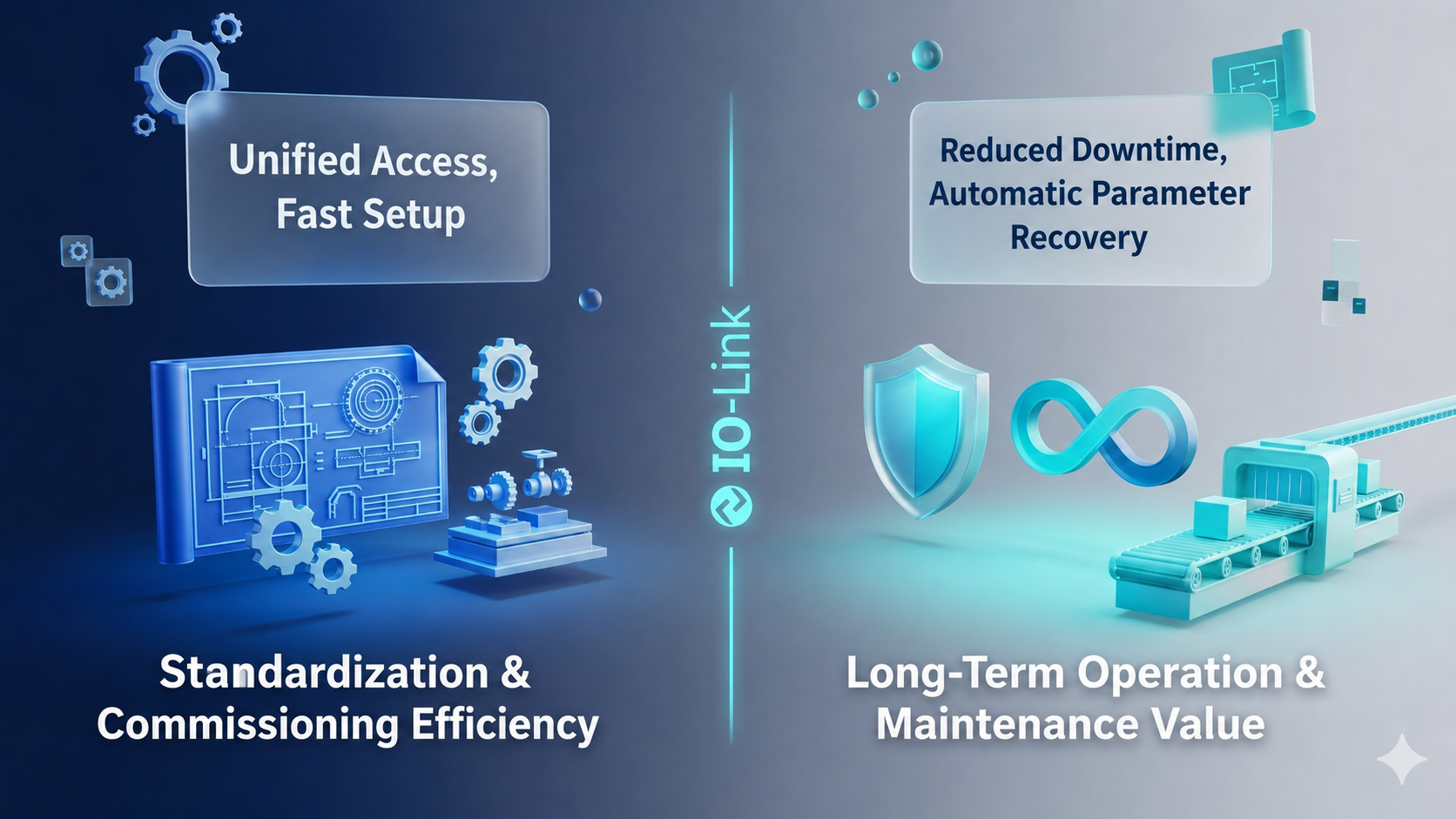
For Equipment Manufacturers: Standardization and Commissioning Efficiency
For equipment manufacturers, the core attraction of IO-Link lies in standardization and commissioning efficiency.
If the same machine needs to redesign signal interfaces every time it is delivered to a different customer site, engineering and commissioning costs will continue to rise. IO-Link provides a unified device access method, allowing sensors, actuators, and I/O modules to be connected to the control system in a standardized way.
For batch manufacturing, export projects, and multi-industry deployment, the time and cost saved can be considerable.
The improvement in commissioning efficiency is also obvious. In traditional field commissioning, a large amount of time is often spent repeatedly checking whether the wiring is correct, whether the parameters are set properly, and whether the device itself is faulty.
IO-Link supports parameterized configuration and diagnostic information reading, enabling engineers to confirm device status more quickly and reduce ineffective troubleshooting time.
For End Users: Long-Term Operation and Maintenance
For end users, the value of IO-Link is more closely related to long-term operation and maintenance.
After a production line has been running for several years, the real cost is often not the initial purchase cost, but downtime losses, troubleshooting labor, false alarm handling, and replacement efficiency.
IO-Link allows device identification, parameter backup, status diagnosis, and abnormal trends to be better integrated into system management.
When a sensor needs to be replaced, the new device can quickly restore the original parameter settings, reducing the risk of human configuration errors.
This is highly practical in applications such as automotive manufacturing, food and beverage production, packaging machinery, electronics manufacturing, lithium battery equipment, and data center liquid cooling systems.
06 | How Sentinel Is Building Its IO-Link Portfolio
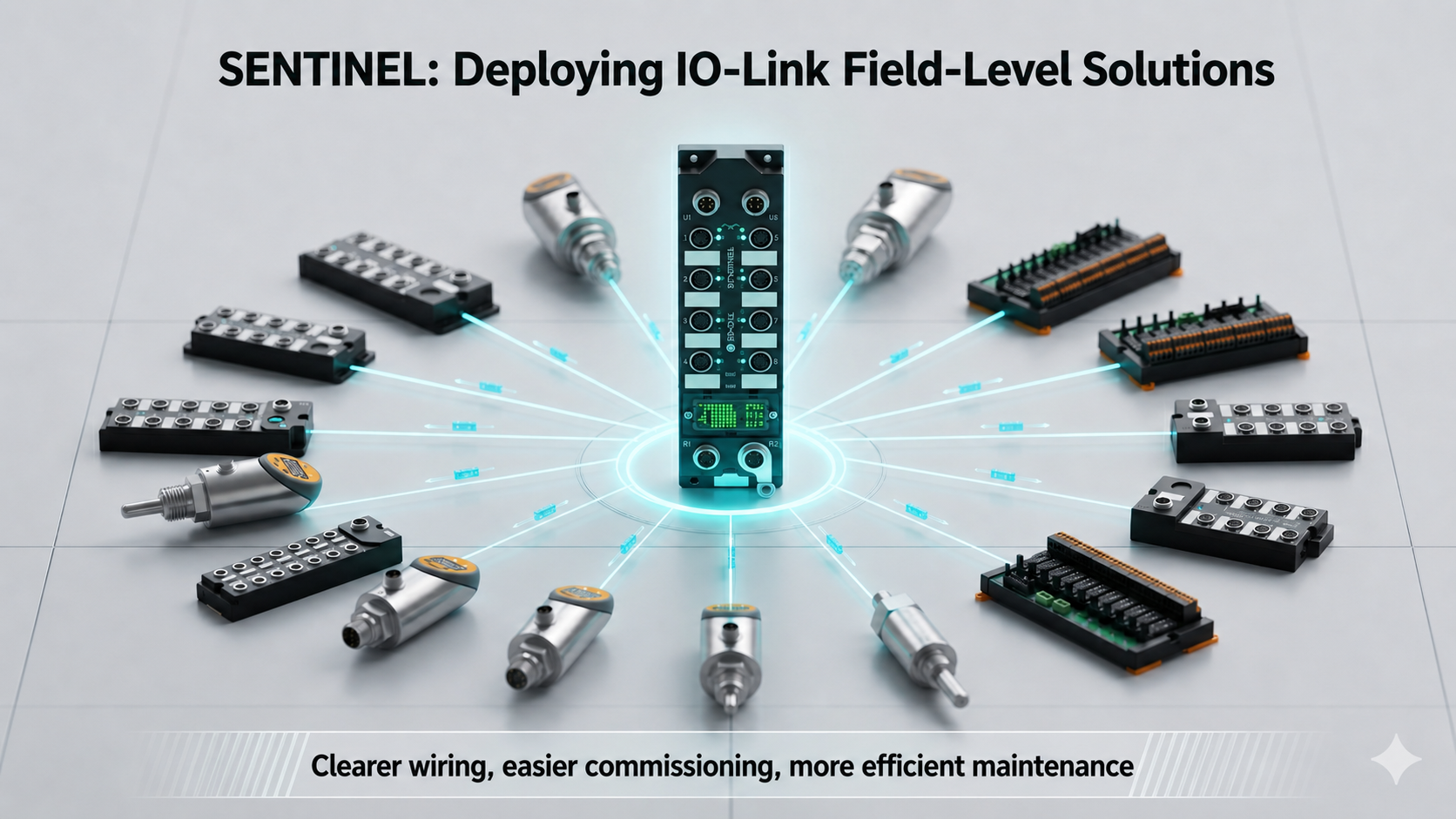
From a product perspective, IO-Link does not exist in isolation. It requires sensors, IO-Link masters, and IO-Link hubs to work together in order to form a complete field-layer solution.
Sentinel continues to develop product lines around industrial field-layer applications, including IO-Link masters, IO-Link hubs, IO-Link converters, IO-Link sensors, and IO-Link relay modules.
The core direction is not to make the system more complicated, but to help customers make field signals clearer, commissioning easier, and maintenance more efficient.
- Equipment manufacturing sites: reducing distributed wiring and repeated commissioning, while improving the standardization level of complete machines.
- Process monitoring applications: enabling pressure, flow, temperature, and level signals to enter the control system more smoothly.
- Multi-point actuator control: using relay modules and IO-Link hubs to centralize output control and make equipment structures more standardized.
More and more devices are choosing IO-Link not because it is meant to replace all traditional signals, but because it adds greater visibility and maintainability to devices on the basis of traditional field interfaces.
This is a real change taking place in the industrial field layer.
Article Summary
From “Connecting Devices” to “Understanding Devices”
Industrial automation is entering a new stage. It is no longer only about achieving control functions, but also about data, diagnostics, and maintenance efficiency.
In the past, as long as a field device could be connected to the system and complete its control action, the task was considered done.
Today, devices need to be identified, configured, diagnosed, and able to provide information before abnormalities grow into serious problems.
The value of IO-Link is becoming increasingly visible in this transformation.
For equipment manufacturers, IO-Link is a path to improving product digitalization and standardization.
For system integrators, it is a tool to reduce commissioning and maintenance complexity.
For end users, it means clearer field status, lower downtime risk, and more sustainable equipment management.
The future of the industrial field is not only about having more devices. It is about making every device more transparent, more controllable, and easier to maintain.
IO-Link is becoming a key interface connecting this change.
FAQ
Q1: Is IO-Link a fieldbus?
No. IO-Link is a point-to-point communication technology designed for sensors and actuators. It is based on the traditional three-wire wiring method and does not require dedicated cables or complex network topology.
It connects to the upper-level control system through an IO-Link master and exchanges data with PLCs or industrial Ethernet systems.
Simply put: IO-Link is lighter than a fieldbus, but smarter than ordinary sensors.
Q2: Why do ordinary sensors need IO-Link?
Ordinary sensors can only tell the system whether something exists or what the measured value is. They cannot provide much more information.
IO-Link sensors additionally provide device identification, parameter configuration, and diagnostic information. This helps the system understand who is reporting, whether the settings are correct, and whether there are abnormal trends.
This is useful for fast commissioning, predictive maintenance, and device replacement. In scenarios with many devices and limited maintenance resources, the difference can be very clear.
Q3: What applications are suitable for IO-Link?
IO-Link is suitable for applications with a large number of devices, frequent commissioning and maintenance, and high requirements for status monitoring and standardization.
Typical applications include automotive manufacturing, packaging machinery, food and beverage production, electronics manufacturing, lithium battery equipment, data center liquid cooling systems, and various automated production lines that require long-term stable operation.
If you care about device status transparency and maintenance efficiency, IO-Link is worth serious consideration.
Customer Support and Service
Tianjin Sentinel Electronics has been deeply engaged in the field of industrial automation for 17 years and has provided more than 170 application cases for industries such as rail transit, automotive manufacturing, and new energy.
We provide full-cycle services covering sensor selection, system integration, and after-sales diagnosis.
To learn more about Sentinel products, please contact our sales team or call us at 022-83726972.
You can also visit our official website:
www.sentinel-china.com
You are welcome to book an online demonstration or apply for a sample trial. Our engineers will help you customize a complete solution from “data acquisition” to “action execution.”